
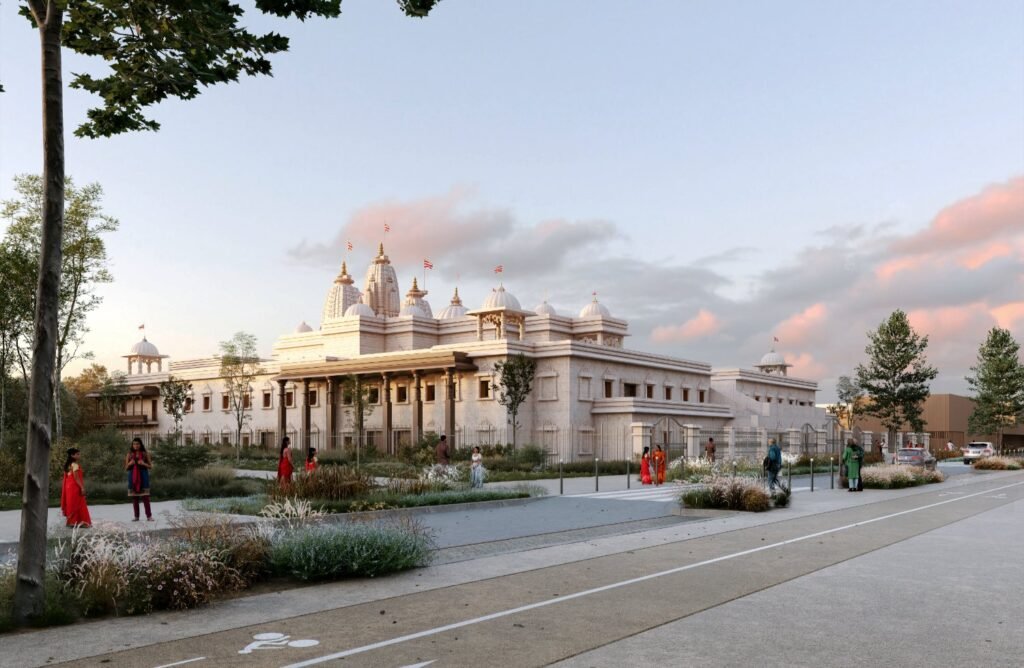
A distinctive new landmark is set to emerge on the outskirts of Paris this September as the BAPS Swaminarayan Hindu Mandir in Bussy-Saint-Georges prepares to welcome visitors. The traditionally designed temple is being presented as France’s first purpose-built traditional Hindu mandir, bringing Indian architecture, worship and cultural traditions to a new setting in the Paris region.
The opening is expected to be more than a single-day ceremony. A 13-day Festival of Culture, scheduled from September 2 to September 14, 2026, will accompany the inauguration and bring together religious ceremonies, cultural programmes and visitors from France and abroad.
A Touch of India in Bussy-Saint-Georges
Located in Bussy-Saint-Georges, in the eastern Paris suburbs, the mandir combines traditional Indian temple design with its French surroundings. The project features carved stonework, shikhars and other architectural elements associated with traditional Hindu temple construction.
For members of the Indian diaspora, the building represents more than architecture. It creates a permanent space where families can gather for prayers, festivals and cultural celebrations, while giving younger generations an opportunity to experience traditions that may otherwise remain connected mainly to family visits to India.
The Opening Will Become a Cultural Festival

The inauguration will be accompanied by the Paris Mandir Mahotsav, a 13-day celebration running from September 2 through September 14. The programme is designed to showcase Indian and Hindu traditions through ceremonies, cultural activities and community events.
The municipality of Bussy-Saint-Georges says the wider festival is expected to attract thousands of visitors. Participants from 38 nationalities are involved, with around 3,000 volunteers supporting the celebrations. A large cultural procession is scheduled for September 13 and will be open to the public.
More Than a Place of Worship
The mandir is being developed with a wider community role in mind. According to the Bussy-Saint-Georges municipality, the site is intended to function not only as a religious space but also as a cultural, educational and community centre promoting dialogue, solidarity and peaceful coexistence.
That wider purpose could make the site attractive beyond the Hindu community. Visitors interested in Indian architecture, craftsmanship and culture will also have an opportunity to experience the traditions associated with the mandir. The official BAPS site says the temple is intended to welcome people of all faiths and backgrounds.
A Significant Moment for the Indian Diaspora
For Indian families living in France and elsewhere in Europe, the opening carries a particular cultural significance. Temples often serve as gathering points where traditions are passed between generations, festivals are celebrated collectively and community networks are strengthened.
The new mandir therefore represents both a religious centre and a connection to Indian heritage. Its location near Paris gives that cultural presence a prominent European setting.
Why the Temple Could Attract Wider Attention
The project stands at the intersection of architecture, culture, diaspora and tourism. Its traditional design makes it visually distinctive, while the September festival gives visitors an extended opportunity to explore Indian traditions rather than simply attending an opening ceremony.
The scale of the celebrations also suggests that the mandir could become a notable cultural destination in the Paris region. Thousands of expected visitors, international participation and the involvement of local authorities are adding to the visibility of the opening.
September 2026 Marks a New Chapter
The BAPS Swaminarayan Hindu Mandir is scheduled to open at a time when cultural exchange and diaspora communities are increasingly visible in major global cities. In Bussy-Saint-Georges, the arrival of a traditionally designed Hindu temple gives Indian heritage a permanent architectural and cultural presence near one of Europe’s best-known cities.
With the September 2–14 Festival of Culture approaching, attention is likely to extend beyond the temple itself to the ceremonies, performances and community activities surrounding its inauguration.
What begins as the opening of a new place of worship could therefore become a much broader celebration of Indian culture in France bringing together faith, architecture, community and international cultural exchange in one landmark setting.