
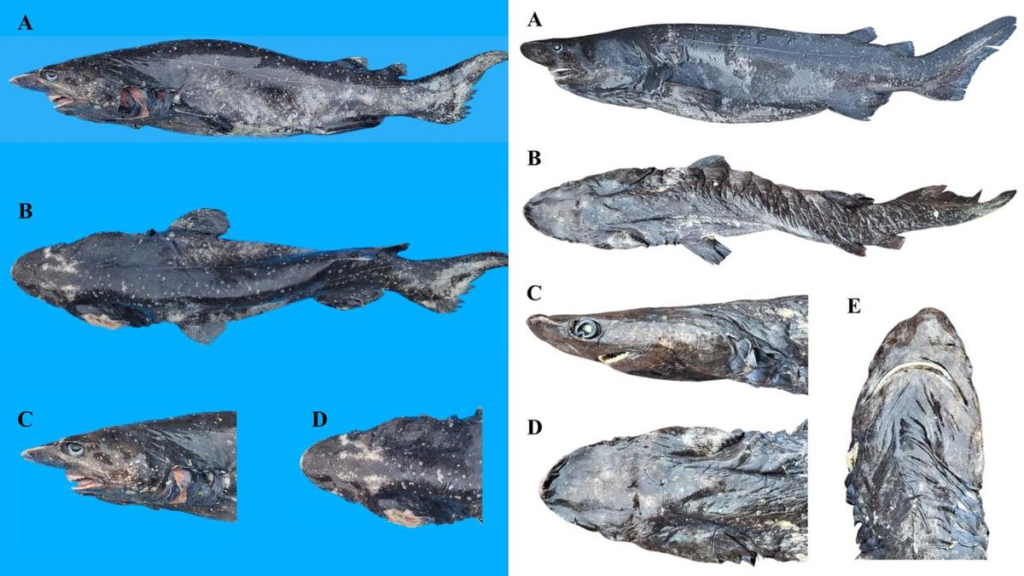
Scientists in India have identified a previously unrecognised species of deep-sea shark in the Indian Ocean after discovering that specimens found along the country’s coastline had been incorrectly classified for decades. The newly identified species, named the Indian Bramble Shark, represents an important development in marine biodiversity research.
Researchers from the Zoological Survey of India (ZSI) and the ICAR-Central Marine Fisheries Research Institute (CMFRI) confirmed that the shark is genetically different from its Atlantic and Pacific relatives. Its scientific name is Echinorhinus roinee.
Shark Found in Kerala Fishing Harbour
The discovery was made through specimens collected at Sakthikulangara Fishing Harbour in Kollam district, Kerala. The sharks had been brought ashore accidentally as bycatch by deep-sea shrimp trawlers.
For several decades, researchers had identified these specimens as Atlantic bramble sharks because of their similar physical appearance. A closer examination of their anatomical features and genetic material eventually revealed that they belonged to a separate species.
The scientific findings have been published in the journal Records of the Zoological Survey of India in 2026.
What Makes the Indian Bramble Shark Different?
The Indian Bramble Shark can grow up to three metres long and generally inhabits deep waters at depths of approximately 350 to 450 metres.
Its body is dark brown to almost black and covered with prominent thorn-like structures. As the shark grows, these structures can merge into larger plates with multiple pointed edges.
Researchers identified several physical differences that distinguish it from related species. These include relatively larger eyes, bigger pelvic fins and a longer region between the snout and gills.
DNA analysis provided further confirmation that the shark represents a distinct Indian Ocean genetic lineage.
DNA Testing Solves a Decades-Old Mystery
Scientists used mitochondrial DNA barcode analysis to compare the newly identified shark with related species.
The results established that Echinorhinus roinee is genetically separate from the Atlantic bramble shark, Echinorhinus brucus, and the Pacific prickly shark, Echinorhinus cookei.
Genetically similar records also suggest that its distribution could extend beyond Indian waters to marine regions near Oman, Sri Lanka and Thailand.
The discovery demonstrates how modern genetic techniques can reveal previously overlooked marine species, even when they closely resemble already known animals.
Why the Discovery Matters for Marine Conservation
The correct identification of the Indian Bramble Shark is important for understanding the biodiversity of India’s deep-sea ecosystems.
These sharks have frequently been caught accidentally in deep-sea fishing operations along India’s southwestern coastline. However, earlier fisheries records and ecological assessments classified them under the Atlantic bramble shark category.
This means that historical information about their population, distribution and vulnerability may need to be reviewed.
Accurate identification will help researchers develop better population assessments, understand fishing-related threats and determine appropriate conservation measures.
Scientists Highlight India’s Unexplored Deep-Sea Biodiversity
The research was conducted by scientists from the Zoological Survey of India and ICAR-CMFRI, with financial support from the Ministry of Earth Sciences under India’s Deep Ocean Mission.
The discovery highlights the importance of continued marine research, particularly in deep-sea environments where many organisms remain poorly understood.
The species name roinee honours Roinee, the daughter of Zoological Survey of India Director Dhriti Banerjee.
A New Chapter in India’s Marine Science Research
The identification of the Indian Bramble Shark is more than the discovery of another marine species. It demonstrates that long-standing assumptions about ocean biodiversity can change when scientists combine detailed anatomical studies with modern DNA technology.
As researchers continue examining deep-sea specimens, additional discoveries could emerge from marine environments that have received relatively limited scientific attention.
The findings also reinforce the importance of accurate species classification in protecting marine ecosystems and improving India’s understanding of its underwater biodiversity.