
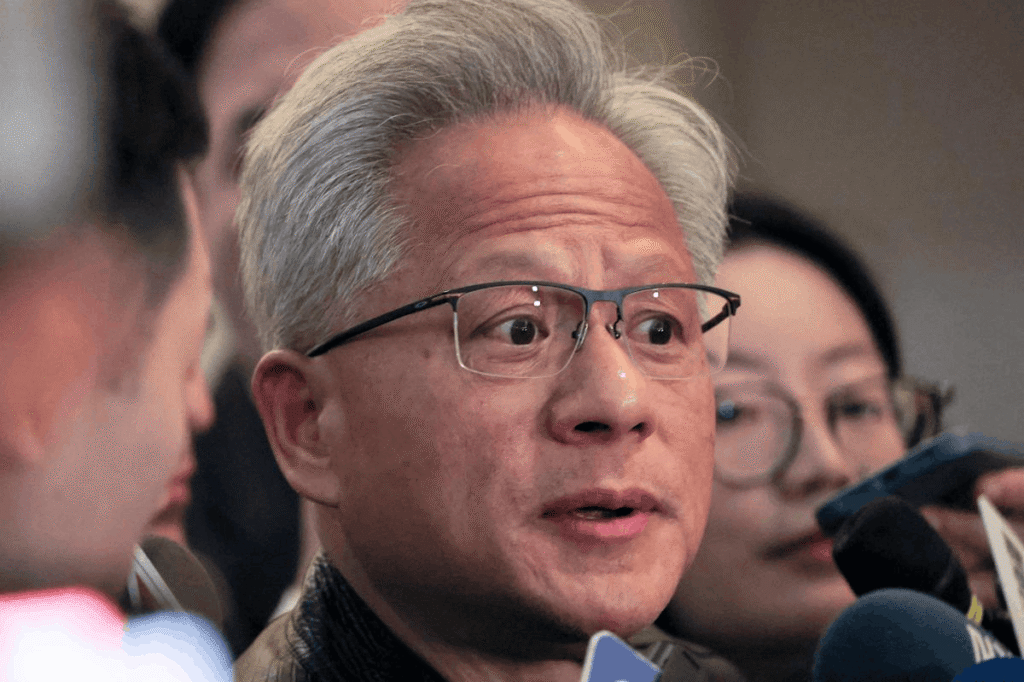
China’s expanding artificial intelligence industry could face fresh challenges as growing US scrutiny of Nvidia threatens billions of dollars in computing projects dependent on the American chipmaker’s advanced processors. A Reuters investigation has identified Chinese AI infrastructure projects and equipment agreements worth more than 23 billion yuan, approximately $3.2 billion, that are built around restricted Nvidia technology.
The developments come amid heightened attention surrounding Nvidia co-founder Jensen Huang’s departure as chief executive and increasing pressure from US lawmakers to tighten restrictions on China’s access to advanced artificial intelligence chips.
Chinese AI Projects Depend on Restricted Nvidia Processors
Reuters examined more than 150 procurement notices, investment plans, construction contracts and corporate disclosures to identify the scale of Chinese investment involving Nvidia processors.
The projects are spread across major technology centres as well as less-developed regions in western China. They include government-backed computing facilities, university projects, regional data centres and commercial infrastructure.
Several developments have been designed around Nvidia’s H100, H200 and H800 processors, which are subject to different US export restrictions.
The estimated $3.2 billion covers planned investments, signed agreements, completed installations and supporting infrastructure such as buildings and power systems. It does not represent spending on Nvidia chips alone.
Export Restrictions Create Uncertainty for Chinese Developers
Washington has gradually tightened restrictions on advanced semiconductor exports to China since 2022. The measures are intended to limit Beijing’s access to computing technology that could support advanced AI development and military applications.
Although Nvidia has said US restrictions have effectively removed it from China’s AI data-centre market, the Reuters investigation indicates that demand for its technology continues among Chinese developers and institutions.
Some projects are already operating or under construction, while others could experience delays, supply shortages or expensive redesigns if access to restricted processors becomes more difficult.
Developers may increasingly need to consider domestic Chinese alternatives to Nvidia hardware.
Jensen Huang’s Departure Adds to Industry Concerns
Huang’s resignation has added another layer of uncertainty to Nvidia’s relationship with China. He had previously supported easing restrictions on American chip exports, arguing that maintaining access to international markets was important for US technology companies.
His departure could weaken Nvidia’s influence in Washington at a time when lawmakers are demanding stronger controls over advanced semiconductor exports.
However, there has been no public finding that Huang violated US export-control laws. Nvidia’s board has also launched an independent investigation into the separate allegations surrounding a former executive associated with its Singapore-based cloud partner Megaspeed.
Megaspeed has denied illegally diverting Nvidia chips to China.
Importantly, the Chinese AI projects identified in the Reuters investigation have not been linked to the separate allegations involving Huang or Megaspeed.
Washington Faces Challenges in Enforcing Chip Restrictions
The United States faces difficulties ensuring that restricted processors do not reach prohibited customers through indirect channels, overseas facilities or third-party arrangements.
In January 2026, the Trump administration moved towards reviewing export licences for H200 processors on an individual basis for eligible Chinese customers, subject to conditions.
Meanwhile, an industry estimate cited by Reuters indicated that Nvidia accounted for 34 per cent of Chinese AI accelerator shipments during the first half of 2026. This measurement differs from Nvidia’s statements about its own direct sales and does not establish how restricted processors reached Chinese users.
China’s AI Expansion Faces a Critical Technology Challenge
The uncertainty surrounding Nvidia’s technology could affect China’s plans to expand AI computing capacity. Access to powerful processors is essential for training advanced models, operating AI applications and supporting large-scale data centres.
If US restrictions become more comprehensive, Chinese developers could face higher infrastructure costs and longer project timelines as they look for alternative processors.
The situation also highlights the wider technology competition between Washington and Beijing, where semiconductor access has become a central economic and national security issue.
The future of these Chinese AI projects will depend partly on how US export regulations evolve, how effectively restrictions are enforced and whether domestic chipmakers can provide alternatives at the required scale.