
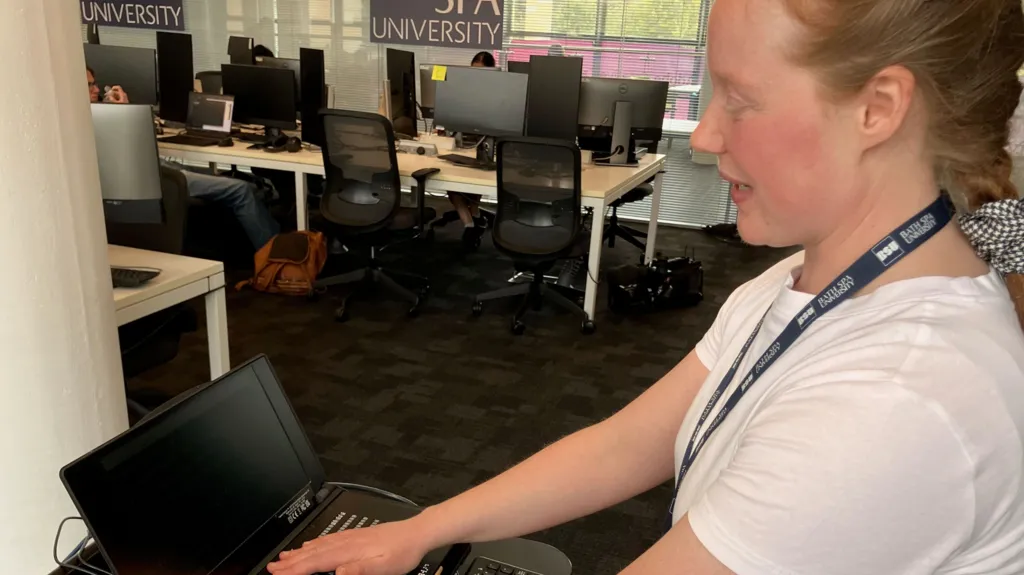
A new braille technology could help people with visual impairments overcome barriers to studying and working in science, technology, engineering and mathematics (STEM). Developed by Bristol Braille, a UK-based not-for-profit organisation, the Canute Scientific is designed to display complex scientific and mathematical information through touch.
The device aims to make digital information easier to access for students, educators and professionals who are blind or have sight loss.
How Does the Canute Scientific Work?
The Canute Scientific resembles a computer keyboard but features multiple rows of braille cells. Small dots rise and fall through openings to display information that users can read with their fingertips.
Unlike traditional single-line braille displays, the device provides multiple lines of information at once. This allows users to read and edit text, access data and work with specialised applications.
The technology is designed to present information in braille in a way that corresponds to what appears on a visual screen.
Supporting Blind Students and Teachers
Hollie Baker, a lecturer at Bath Spa University who is blind, says the device could make teaching and accessing information easier.
Traditional single-line braille displays can make it difficult to navigate lengthy notes, while synthetic speech can sometimes be distracting. A multi-line display could help educators follow their material more smoothly and manage complex information more independently.
The technology could also benefit students who need to work with mathematical expressions, scientific data and other technical content.
Breaking Barriers in STEM Careers
People with visual impairments can face accessibility challenges when studying technical subjects, particularly when information relies heavily on visual diagrams, equations and data displays.
Devices such as the Canute Scientific could help reduce some of these barriers by offering an alternative way to access digital content. Greater access to scientific and mathematical information could support more inclusive learning and employment opportunities.
A New Step in Assistive Technology
Braille was developed by Louis Braille in the 19th century and remains an important method of reading and writing for blind people. Digital braille devices have expanded its use beyond printed material, allowing users to interact with computers and electronic information.
Bristol Braille says its work focuses on developing technology alongside braille users. The Canute Scientific represents another effort to make specialist digital information more accessible.
Although technology alone cannot remove every barrier faced by people with sight loss, innovations like this could help create more inclusive classrooms and workplaces, particularly in fields where access to detailed technical information is essential.