
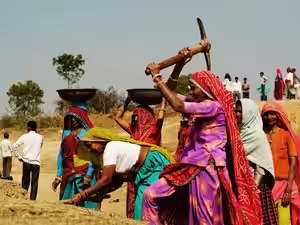
The Congress party has criticised the Centre’s new rural employment law, the Viksit Bharat Guarantee for Rozgar and Ajeevika Mission (Gramin), or VB-G RAM G Act, alleging that it could make access to employment more difficult for vulnerable rural communities and reduce the role of gram panchayats.
Congress general secretary Jairam Ramesh raised concerns over the scheme’s technology-based systems, centralised implementation and changes affecting households covered under the Forest Rights Act (FRA), 2006. His remarks have renewed the political debate over rural employment security following the replacement of the Mahatma Gandhi National Rural Employment Guarantee Act (MGNREGA).
1. Congress Questions Changes to Rural Employment Guarantees
Ramesh alleged that the new law weakens protections previously available to rural workers under MGNREGA. He also accused the government of pushing the legislation through Parliament without adequate consideration of its potential impact on vulnerable households.
The Congress has argued that the earlier employment framework provided rural families with a statutory route to seek wage employment and helped strengthen local decision-making through village panchayats.
2. Concerns Over Additional Workdays for Tribal Families
A key issue raised by the opposition concerns households holding titles under the Forest Rights Act. Under the previous MGNREGA framework, eligible FRA beneficiaries were covered by a provision allowing up to 150 days of employment in a year, compared with the standard 100-day guarantee.
According to Ramesh, these households face uncertainty over whether the additional employment entitlement will continue under the new system. He argued that the change could affect tribal communities and other traditional forest dwellers who depend on wage employment for their livelihoods.
3. Technology-Based Systems Under Scrutiny
The Congress has also raised concerns about digital attendance monitoring, Aadhaar-linked payment arrangements and the deletion of job cards. Ramesh alleged that these mechanisms have contributed to the exclusion of workers from employment benefits.
Digital systems can support transparency and reduce irregularities, but their implementation also raises questions about access for people who encounter biometric authentication failures, connectivity problems or documentation difficulties.
The extent to which these challenges affect workers under the new law remains an important issue for monitoring.
4. Gram Panchayats at the Centre of the Debate
Another major point of disagreement is the role of gram panchayats in planning and implementing rural employment programmes.
The Congress argues that centralised decision-making could weaken local institutions and limit their ability to respond to the needs of village communities.
The Centre, however, maintains that the new framework gives panchayats an important role in preparing village development plans, registering households, processing work applications and implementing approved projects. The government’s stated framework also includes digital records and social audits intended to strengthen accountability.
5. How the New Law Differs From MGNREGA
The VB-G RAM G Act replaced MGNREGA nationwide from July 1, 2026. According to the Union government’s explanation, the new law provides a statutory guarantee of 125 days of wage employment per financial year to eligible rural households whose adult members volunteer for unskilled manual work.
The government has presented the framework as a way to connect employment with durable infrastructure, livelihood generation, water security and rural development.
The opposition’s criticism, meanwhile, centres on whether the changes to implementation, funding responsibilities and access requirements could undermine the employment security previously available to workers.
6. What It Means for Rural India
The debate has significant implications for rural households, particularly tribal communities, forest dwellers and families that rely on public employment during periods of limited agricultural work.
Key questions include whether eligible workers can access employment without technical barriers, whether wage payments arrive on time, and whether local authorities retain sufficient flexibility to identify and approve work based on village needs.
Clear implementation guidelines, accessible grievance-redressal systems and transparent reporting of employment data will be important in assessing how the new framework performs.
7. Rural Employment Policy Faces Fresh Political Debate
The dispute over the VB-G RAM G Act reflects broader differences between the government and opposition over how rural employment should be guaranteed and administered.
While the Centre emphasises expanded employment days and the creation of productive rural assets, the Congress has warned about potential exclusion, centralisation and uncertainty over existing entitlements.
The practical impact of the new framework will depend on how its provisions are implemented and whether eligible rural workers can effectively access employment and payments. Its effects on tribal households and the authority of gram panchayats are likely to remain central to the debate.