
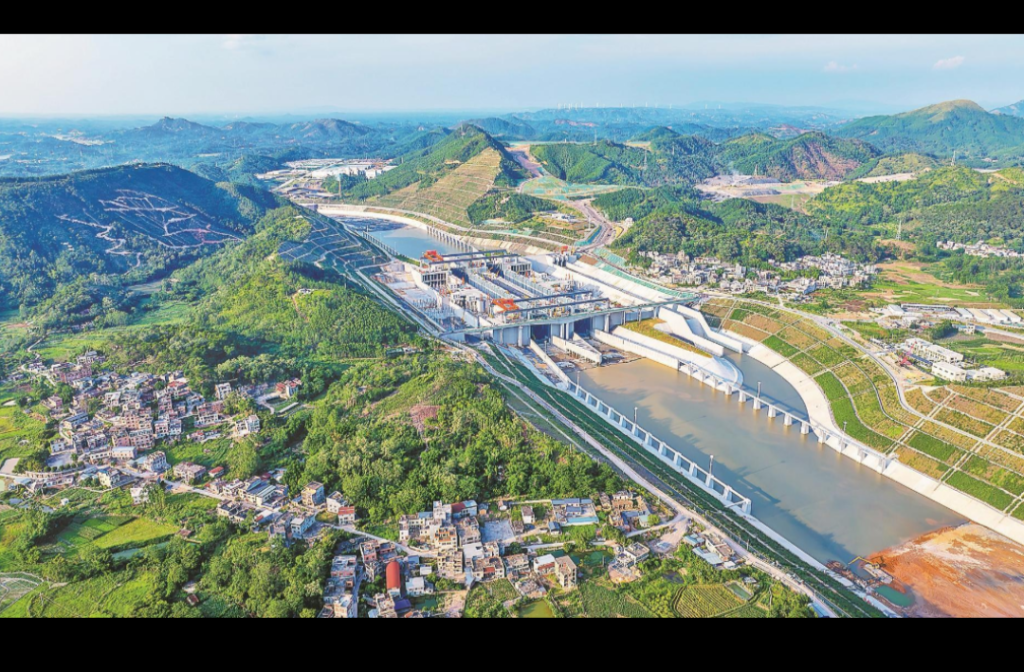
China has officially opened the Pinglu Canal to commercial navigation, creating a major new river-to-sea waterway that gives inland southwestern regions direct access to the sea and shortens trade routes to Southeast Asia.
The 134.2-kilometre canal in Guangxi Zhuang Autonomous Region became operational on September 16, 2026. It links the Xijiang River system near Nanning with the Beibu Gulf (Gulf of Tonkin), allowing cargo from inland provinces to reach the coast without the previous long detour via Guangzhou.
This is China’s first major river-to-sea canal planned and coordinated at the national level since 1949. Construction began in August 2022 at a cost of approximately 72.7 billion yuan (about $10.8 billion). The waterway is designed for vessels of up to 5,000 tonnes and features three major ship-lock hubs at Madao, Qishi, and Qingnian
Shortens the inland waterway distance to the sea by more than 560 kilometres.
Expected to reduce overall logistics costs by 18% to 30%.
Projected annual transport cost savings of over 5 billion yuan.
Provides a more direct maritime gateway for goods from southwestern China (including Chongqing, Sichuan, Yunnan, Guizhou and Guangxi) to ASEAN markets.
On opening day, around 30 cargo vessels carrying building materials, coal, minerals, steel, fertiliser and other goods began using the canal. New freight routes also started operating, including an international service linking Nanning with Can Tho in Vietnam and a domestic route to Yangpu in Hainan.
Strategic Importance
The Pinglu Canal forms a backbone project of the New International Land-Sea Trade Corridor (also linked to the New Western Land-Sea Corridor and the Belt and Road Initiative). It strengthens multimodal transport connecting rail, river and sea, giving western and southwestern China a shorter, more economical outlet to Southeast Asia.
China and ASEAN have been each other’s largest trading partners for consecutive years. The canal is expected to boost industrial chain integration, lower costs for Chinese exports to the region, and ease the flow of ASEAN goods (such as agricultural products) deeper into China’s interior. Throughput is projected to reach about 5 million tonnes in 2026 and rise significantly in following years.
Chinese Vice Premier Ding Xuexiang attended related events and highlighted the canal’s role in expanding opening-up in western regions and developing Beibu Gulf ports as international gateways.The project also incorporates ecological measures, including fish passages and wildlife crossings, as authorities balance infrastructure development with environmental protection.
With the canal now operational, southwestern China’s manufacturers and exporters gain a competitive logistics advantage. Analysts see it as a catalyst for greater regional connectivity, supporting higher trade volumes between China and ASEAN while advancing China’s broader goals of coordinated regional development and high-standard opening-up.
The Pinglu Canal marks a significant addition to Asia’s transport infrastructure — turning a traditional inland hinterland into a more direct player in maritime trade with Southeast Asia.