
For almost 100 years, mathematicians have wrestled with a fundamental question about the equations that describe moving fluids. Now, artificial intelligence has entered this difficult area of mathematics with a proposed solution that could become a major scientific milestone.
OpenAI says its AI system has produced a proposed solution to the Navier–Stokes existence and smoothness problem, one of the seven Millennium Prize Problems. The challenge carries a $1 million prize from the Clay Mathematics Institute. OpenAI has said it would not claim the prize if the work is ultimately accepted.
Why the Problem Is So Difficult
The Navier–Stokes equations are used to describe fluid motion and have applications ranging from weather and ocean modelling to aircraft design and industrial machinery. The equations themselves are well established, but mathematicians have not proved whether their solutions always remain mathematically well behaved.
One possible outcome is a phenomenon called blowup, where quantities such as fluid velocity could become unbounded within a finite period. Determining whether this can happen is at the heart of the problem.
How AI Tackled the Question
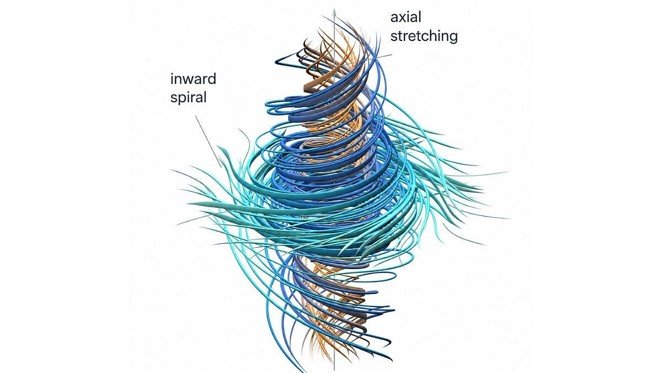
According to OpenAI, thousands of AI agents worked simultaneously on the challenge. The system reportedly found a scenario involving a vortex that becomes narrower and faster, potentially reaching a singularity in finite time.
The proposed proof is more than 160 pages long and has been checked using Lean, a system for formal verification of mathematical proofs. However, that does not mean the problem has been definitively solved. Mathematicians still need to examine the full argument and decide whether every step meets the required standard.
A Debate About Credit
The development has also raised questions about scientific credit and the role of AI in research. Tristan Buckmaster and Levent Alpöge had been working on a related fluid-dynamics problem involving the forced Euler equations. OpenAI has denied direct access to their private research while acknowledging that indirect influence from de-identified product data cannot be completely ruled out.
What Comes Next
For now, the most careful description is that AI has produced a potentially groundbreaking proposed solution. If independent mathematical scrutiny confirms it, the result could demonstrate how AI and human researchers can work together on problems that have resisted traditional approaches for decades.