
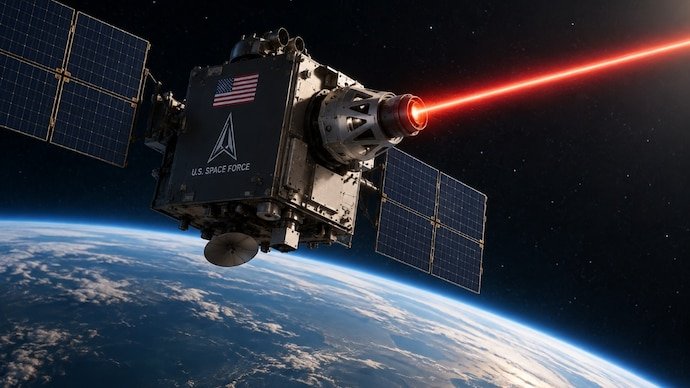
The United States has publicly confirmed for the first time that it has deployed space-control weapons in Earth’s orbit, marking a significant development in the growing militarisation of space. U.S. Air Force Secretary Troy Meink said the weapons are intended to defend American forces against hostile actions, but officials have not disclosed their exact type, number or location.
The announcement was made at the Air, Space and Cyber Conference in Maryland. According to the U.S. Space Force, “space control” can involve both kinetic and non-kinetic capabilities designed to affect an adversary’s space systems. Officials said such capabilities may be used for defensive as well as offensive purposes.
The disclosure comes amid long-standing U.S. concerns over the space capabilities of China and Russia. Satellites play a major role in communications, navigation, surveillance and military operations, making space-based systems increasingly important to national security.
The disclosure comes amid long-standing U.S. concerns over the space capabilities of China and Russia. Satellites play a major role in communications, navigation, surveillance and military operations, making space-based systems increasingly important to national security.
China has criticised the development, warning against turning outer space into a battlefield or triggering an arms race. Russia has also called for space to remain free of weapons.
The development has also renewed attention on international rules governing military activity in space. The 1967 Outer Space Treaty prohibits placing nuclear weapons and other weapons of mass destruction in orbit, but it does not prohibit every type of conventional or non-kinetic military capability in space.
The exact capabilities acknowledged by Washington remain unclear. Officials have not confirmed whether the systems involve jamming, lasers, cyber capabilities or other technologies. Experts quoted by international media say the public disclosure could influence how Russia and China develop their own counter-space capabilities.
The announcement therefore places renewed focus on the future of space security, satellite protection and international arms-control discussions.