
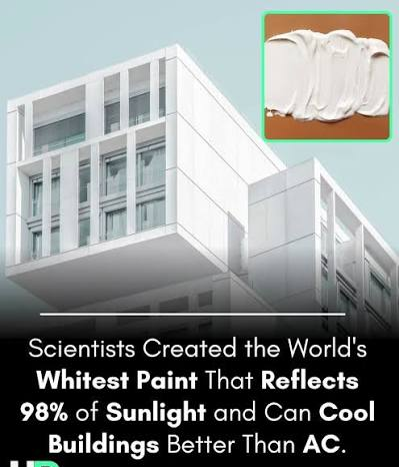
As temperatures rise, keeping buildings comfortable can require more electricity for air conditioning. Scientists are exploring another approach: surfaces designed to reflect sunlight and release heat naturally.
Researchers at University College London have developed an experimental coating that reportedly reflects about 93% of incoming sunlight, compared with roughly 84% for conventional white paint. In tests in Madrid, coated surfaces were up to 8°C cooler than surfaces covered with standard white paint.
How the Cooling Works
Radiative cooling relies on two basic ideas. First, a surface reflects as much solar energy as possible, reducing the heat it absorbs. Second, heat already stored in the material can leave as infrared radiation. Some of that radiation can pass through the atmosphere and escape into space.
Roofs are especially important because they receive strong direct sunlight. A cooler roof could reduce the amount of heat transferred into the building, potentially helping in hot climates where cooling demand is high.
Beyond Paint
Scientists are also studying materials that combine reflective cooling with evaporation. Some cement-based materials contain tiny pores that hold water. As the water evaporates, it carries heat away from the surface.
One reported trial found such a material stayed about 5°C cooler than a standard radiative coating and produced significant energy savings in an air-conditioned building.
The Road Ahead
Some radiative-cooling products are beginning to reach the market, but newer materials still require development. Passive cooling surfaces could eventually become one part of a wider strategy for reducing heat and electricity use in buildings.