
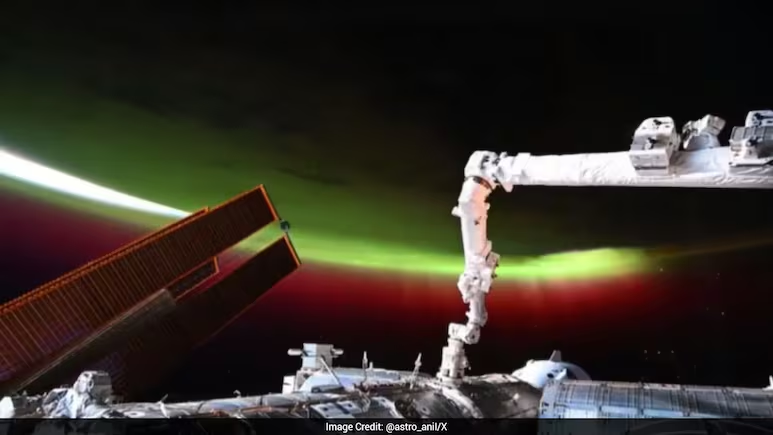
NASA astronaut Anil Menon has shared a breathtaking view of a green aurora from the International Space Station (ISS), offering a spectacular glimpse of Earth’s natural light display. The video, posted on October 10, captured the glowing colours above the planet following significant solar activity.
Anil Menon Shares the View From Space
Menon shared the video on X, expressing his amazement at the scene. He described it as an incredible aurora witnessed from the space station.
The footage attracted attention online, with viewers praising the vivid colours and the extraordinary perspective astronauts experience while orbiting Earth.
What Is an Aurora?
An aurora is a natural light display that occurs when charged particles from space interact with gases in Earth’s upper atmosphere. These interactions release energy in the form of light, creating colourful patterns that often appear near the polar regions.
Auroras are commonly called the Northern Lights in the Northern Hemisphere and the Southern Lights in the Southern Hemisphere.
Why Does the Aurora Glow Green?
Green is one of the most common aurora colours. It is generally produced when energetic particles interact with oxygen atoms at altitudes of roughly 100 to 300 kilometres.
Depending on atmospheric conditions and the energy of incoming particles, auroras can also display red, purple, pink and blue shades.
How Solar Activity Triggers Auroras
The Sun regularly releases energy and charged particles into space. During events such as coronal mass ejections, large clouds of magnetised solar material travel outward and may interact with Earth’s magnetic field.
When these interactions disturb the magnetosphere, more charged particles can enter the upper atmosphere and produce brighter auroras. Recent solar activity contributed to heightened geomagnetic activity around October 10–11, 2026.
Why Auroras Look Different From the ISS
From the ground, auroras appear across the night sky, often as curtains or bands of light. Astronauts aboard the ISS can see the glowing display from above, with the atmosphere and Earth’s curved horizon providing a unique perspective.
The orbital view helps illustrate how these colourful phenomena occur high above the planet’s surface.
Social Media Reacts to the Spectacular Footage
Menon’s video drew enthusiastic responses from viewers, who described the aurora as beautiful and electrifying. The post offered people a rare opportunity to appreciate a natural phenomenon through an astronaut’s perspective.
A Reminder of the Sun’s Influence on Earth
Auroras are beautiful, but the solar activity behind them can also affect technology. Strong geomagnetic storms may disrupt satellite operations, radio communications and navigation systems, although the actual effects depend on storm intensity.
Menon’s footage captures the visual wonder of space weather while highlighting the dynamic relationship between the Sun and Earth.