
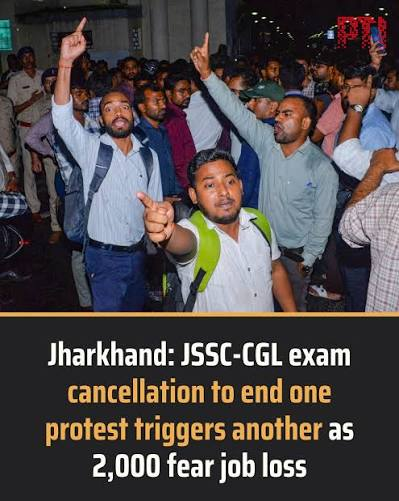
A decision intended to address concerns over recruitment examinations in Jharkhand has opened a new chapter of uncertainty for thousands of candidates who had already cleared one of the affected exams.
The Jharkhand government has cancelled the Jharkhand Staff Selection Commission Combined Graduate Level (JSSC-CGL) examination, along with recruitment tests conducted by outsourced agency TSR Data Processing Pvt Ltd (TDPL) since 2014. The decision followed weeks of protests by job aspirants who had raised allegations of irregularities in the state’s recruitment process.
But while the cancellation was welcomed by protesting aspirants as an important step, it has triggered another protest from candidates who successfully cleared the JSSC-CGL examination and were subsequently appointed to government positions.
Why Was the JSSC-CGL Exam Cancelled?
The cancellation came after sustained protests over alleged problems and irregularities surrounding recruitment examinations in the state.
The Jharkhand government announced that the JSSC-CGL exam and other tests conducted by TDPL would be cancelled as part of a broader effort to address concerns surrounding the recruitment system.
Chief Minister Hemant Soren has also announced plans for an examination-reform committee headed by senior IAS officer Amitabh Kaushal. The committee is expected to examine the recruitment system and work toward improving its functioning.
The government has described the move as part of efforts to improve transparency and reform the recruitment process.
A New Protest Emerges
The cancellation, however, did not bring an end to the controversy.
Around 2,000 successful candidates have expressed concern that cancelling the examination could put their appointments and careers at risk. Many of them gathered outside the Jharkhand Secretariat in Ranchi to voice their opposition to the decision.
For these candidates, the issue is different from that of those who were demanding cancellation of the examination.
They argue that they successfully completed the recruitment process and received appointments. They now want the government to protect their employment while investigating any alleged irregularities.
Candidates Demand a Fair Solution
The affected employees say they are not necessarily opposed to an investigation into the recruitment process. Their concern is what happens to candidates who entered government service after successfully completing the examination.
Some have also raised concerns about age limits. If the recruitment process is restarted after several years, candidates who have crossed the eligibility age could find themselves unable to compete again.
This has made the dispute particularly sensitive because the candidates say they could lose an opportunity that they had already earned through the recruitment process.
Demand for a CBI Investigation
The demand for an investigation has become another important part of the dispute.
Both groups involved in the controversy have sought greater clarity over the alleged irregularities, with demands for a Central Bureau of Investigation (CBI) probe being raised.
Student protesters have argued that an independent investigation is necessary to establish what happened and determine responsibility. At the same time, successful candidates believe an impartial investigation could help distinguish between genuine wrongdoing and candidates who cleared the examination without involvement in any alleged malpractice.
Government Says Legal Options Remain
The state government has indicated that candidates affected by the cancellation can pursue legal remedies.
Higher and Technical Education Minister Sudivya Kumar said successful candidates have the option of seeking legal recourse. Meanwhile, ruling JMM representatives have acknowledged the concerns of those who fear losing their jobs.
The response highlights the difficult position facing the government: addressing allegations surrounding recruitment while also dealing with the rights and expectations of people who have already been appointed.
One Decision, Two Groups of Candidates
The situation has created an unusual divide.
On one side are aspirants who believe cancelling the disputed examinations is necessary to restore confidence in the recruitment system.
On the other are successful candidates who fear that the same cancellation could undo the appointments they worked years to obtain.
Both groups are seeking fairness, but their immediate interests are now in conflict.
What Happens Next?
The immediate focus will be on how the government implements the cancellation order and what mechanism it establishes for examining the alleged irregularities.
The proposed examination-reform committee could play an important role in determining how future recruitment tests are conducted. Meanwhile, the legal position of candidates who have already been appointed remains a major question.
The continuing demand for an independent investigation could also keep the issue in the spotlight.
A Larger Question About Government Recruitment
The JSSC-CGL controversy has moved beyond a single examination.
It has raised broader questions about how government recruitment examinations should be conducted, how alleged irregularities should be investigated and how authorities should protect candidates who are not responsible for any wrongdoing.
For young people preparing for government jobs, recruitment examinations represent years of preparation and significant career expectations. Any disruption can therefore have consequences extending far beyond the examination hall.
The Jharkhand government’s next steps will determine whether the current controversy becomes a starting point for meaningful recruitment reform or leads to another prolonged legal and administrative dispute.
For now, the cancellation may have addressed one side of the protest, but it has created a new and equally serious question: how should the government balance recruitment transparency with the rights of candidates who have already been selected and appointed?