
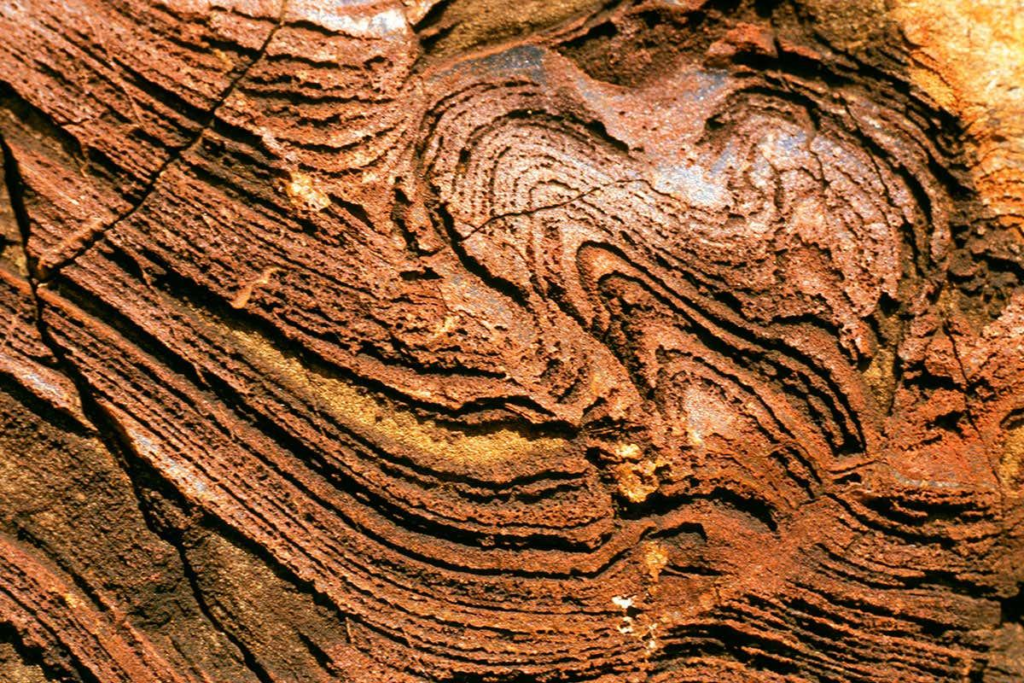
A remarkable geological discovery in eastern India is giving scientists a new window into the planet’s distant biological past. Researchers have identified possible signs of ancient microbial activity preserved inside a layered rock estimated to be around 3.4 billion years old.
The finding is attracting attention because it could help scientists understand when and how some of the earliest forms of life emerged on Earth. The reported evidence comes from rocks formed during the Archean Eon, a period when the planet looked dramatically different from the world we know today.
A rock from an almost unrecognisable Earth
Around 3.4 billion years ago, Earth was still in its early stages of development. The atmosphere was very different, continents were taking shape and much of the planet’s surface was influenced by volcanic and marine environments.
The newly reported rock preserves structures and chemical characteristics that researchers interpret as possible biosignatures—features that may have been produced by living microorganisms.
If the interpretation is confirmed, the discovery would add important evidence to the growing scientific picture of life existing on Earth remarkably early in the planet’s history.
What are biosignatures?
Scientists cannot simply look at an ancient rock and identify a microorganism that lived billions of years ago. Instead, they search for physical and chemical clues left behind by biological activity.
These clues can include unusual structures, patterns in minerals and chemical compositions that are consistent with microbial processes.
That makes the study of extremely old rocks challenging. Geological processes can sometimes create structures that resemble biological remains, so researchers have to examine multiple lines of evidence before reaching a conclusion.
Why microbial life matters
The possible evidence does not point to complex animals or plants. The earliest life on Earth would have been microscopic and relatively simple.
Microorganisms were capable of surviving in environments that would have been extremely hostile to modern organisms. Studying them can help researchers reconstruct the conditions under which life first became established.
The Indian discovery therefore has significance beyond geology. It could contribute to one of science’s biggest questions: how early did life begin on Earth, and what conditions allowed it to survive?
India’s ancient rocks become a scientific time capsule
Ancient geological formations can preserve information that has survived for billions of years. Researchers study their minerals, chemical signatures and microscopic structures to reconstruct Earth’s early environment.
The significance of the Indian rock lies not simply in its age, but in the possibility that biological activity has been preserved within such an ancient geological record.
The finding also highlights the scientific importance of India’s ancient rock formations, which contain valuable evidence about the country’s geological evolution and Earth’s early history.
Is this definitely the oldest evidence of life?
This is where scientists need to be cautious.
The new finding has been described in recent reports as potentially representing the oldest evidence of life on Earth, but claims about Earth’s earliest life remain an active area of scientific debate. Other rocks around the world have produced proposed evidence of life dating back roughly 3.5 billion years or more, and some of those interpretations remain disputed.
For that reason, it is more accurate to describe the Indian discovery as potentially among the oldest evidence of life yet identified, rather than presenting the claim as permanently settled.
What the discovery could teach scientists
If the biological interpretation withstands further investigation, the rock could help researchers better understand:
- when microbial ecosystems appeared on early Earth;
- what environments supported some of the planet’s earliest organisms;
- how biological activity became preserved in ancient rocks;
- how Earth’s early atmosphere and oceans interacted with primitive life; and
- where scientists should look for similarly ancient biosignatures.
The research could also have implications beyond Earth. Understanding what the earliest signs of life look like on our planet is useful when scientists search for possible evidence of ancient microbial life elsewhere in the Solar System.
A tiny clue from an enormous stretch of time
A rock that appears ordinary today can contain a record dating back billions of years. That is what makes discoveries like this so scientifically valuable.
The reported 3.4-billion-year-old Indian rock does not tell the entire story of life’s origins, but it may provide another important piece of the puzzle. Further analysis will determine how strong the biological evidence is and how the discovery fits into the broader record of Earth’s earliest life.
For now, the finding offers a fascinating reminder that some of the biggest scientific questions may be hidden inside rocks that have been sitting quietly beneath our feet for billions of years.