
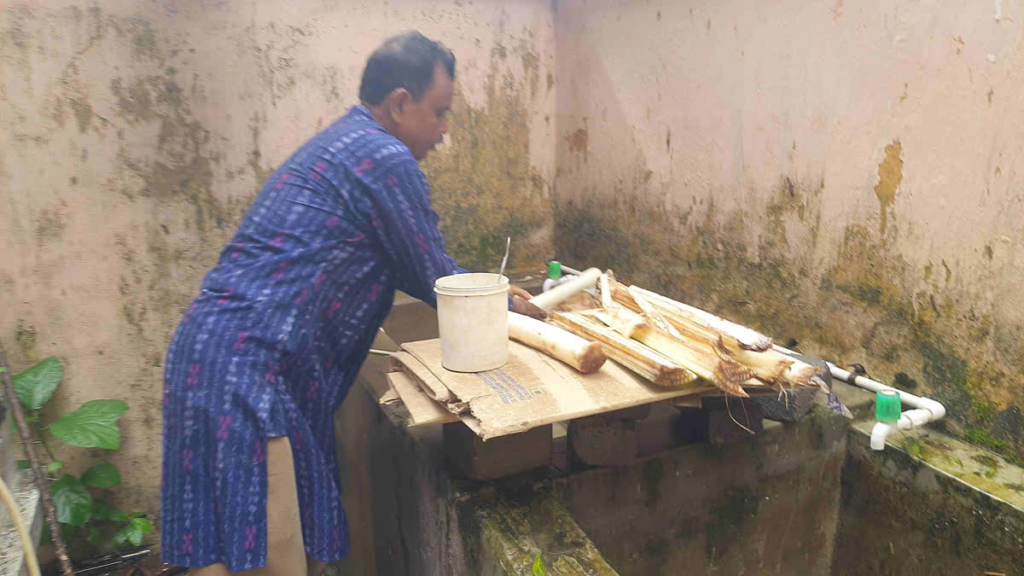
What looks like agricultural waste to most people is becoming a useful resource for mushroom cultivation in Odisha.
A professor in Sambalpur has been working on an unusual approach that gives discarded banana stems a second life: using them as part of the growing process for mushrooms and demonstrating the technique to farmers.
The idea combines two problems faced by agriculture—farm waste and the search for additional sources of income—into one practical experiment.
A Different Use for Banana Stems
Banana plants generate large amounts of plant material after harvesting. Stems that are no longer needed are often left in fields or discarded.
Instead of treating them simply as waste, the Sambalpur initiative explores their potential as a growing material for mushrooms.
The concept is supported by agricultural research. Studies conducted in the Sambalpur region have examined different agricultural residues, including banana leaves, as substrates for mushroom cultivation and found that plant waste can support mushroom growth under suitable conditions.
Turning Waste Into a Farming Opportunity
The most interesting part of the initiative is its focus on farmers.
Rather than keeping the technique inside a laboratory or classroom, the professor is reportedly training farmers to understand how agricultural leftovers can be incorporated into mushroom production.
For farmers, such an approach could offer two potential benefits: reducing the amount of plant material that needs to be discarded while creating another agricultural product that can be sold.
Mushroom cultivation is already an established livelihood activity in Odisha, with training programmes and farms operating across the state.
Why Mushrooms?
Mushrooms are particularly interesting for small-scale cultivation because they do not require the same amount of conventional farmland as many field crops.
Different mushroom varieties can be grown using suitable agricultural residues, including straw and other plant materials. Researchers in Sambalpur have previously studied substrates such as paddy straw, banana leaves, maize residues and other agricultural materials for mushroom production.
That makes the idea especially relevant in farming communities where crop residues are readily available.
A Small Idea With a Bigger Message
The experiment also reflects a growing interest in the circular use of agricultural resources—finding ways to turn something left over from one farming activity into an input for another.
Instead of following a simple cycle of growing crops and throwing away the remaining plant material, farmers can look for ways to extract additional value from what is left behind.
Similar initiatives elsewhere in Odisha have already demonstrated how agricultural waste can be redirected into mushroom cultivation and other livelihood activities.
From Classroom Knowledge to the Farm
What makes the Sambalpur story particularly interesting is the connection between academic knowledge and everyday farming.
A professor experimenting with an unconventional mushroom-growing material may sound like a niche scientific story. But when the technique reaches farmers, the idea becomes much more practical.
It shows how agricultural innovation does not always require expensive machinery or futuristic technology. Sometimes, the solution can begin with something that is already lying in a field.
For Odisha’s farmers, a discarded banana stem could therefore become more than waste it could become the starting material for a new crop, an additional income opportunity and a simple example of turning farm leftovers into value.