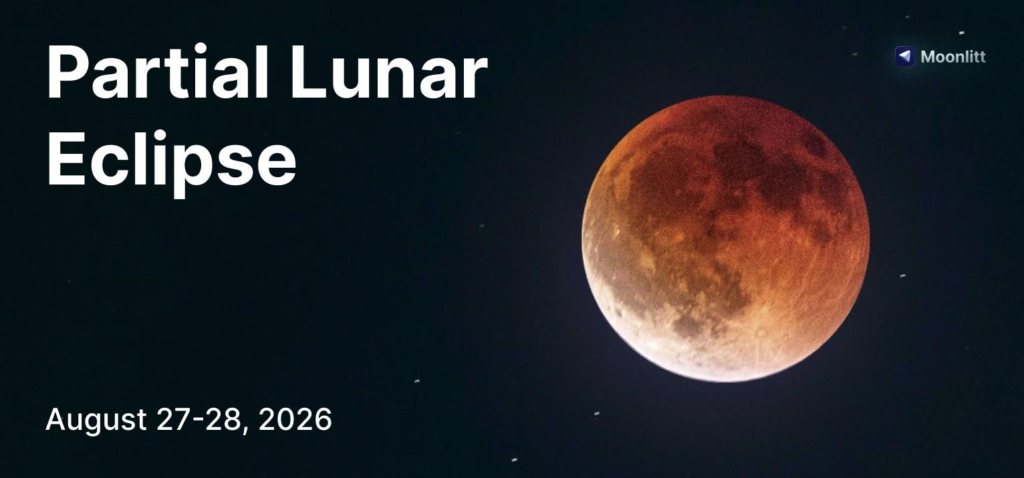
Skywatchers are preparing for one of August 2026’s most striking celestial events—a deep partial lunar eclipse that will take place on August 27–28. At the height of the eclipse, approximately 96.3% of the Moon’s disk will be inside Earth’s darkest shadow, making the event look remarkably close to a total lunar eclipse.
Unlike a total lunar eclipse, however, a small portion of the Moon will remain outside Earth’s central shadow. That narrow bright section is what makes this event scientifically a deep partial lunar eclipse.
How the Eclipse Will Happen
A lunar eclipse occurs when Earth moves directly between the Sun and the full Moon. Earth’s shadow then falls across the lunar surface.
The darkest central portion of that shadow is called the umbra. During the August event, the Moon will move extremely deep into the umbra, with more than 96% of its surface covered at maximum eclipse.
The partial phase begins at 2:34 UTC on August 28, with the greatest eclipse occurring at approximately 4:13 UTC. Local times will vary depending on where observers are located.
Why the Moon Can Turn Red
The dramatic reddish or coppery appearance comes from Earth’s atmosphere.
Although Earth blocks direct sunlight from reaching the Moon, some sunlight passes through the planet’s atmosphere. The atmosphere scatters shorter blue wavelengths more strongly while allowing more red and orange light to travel toward the lunar surface.
That filtered light can illuminate the portion of the Moon inside Earth’s umbra, creating the familiar reddish appearance associated with a “Blood Moon.”
Because almost the entire lunar disk will enter the umbra this time, the color contrast could be particularly dramatic.
Where Will It Be Visible?
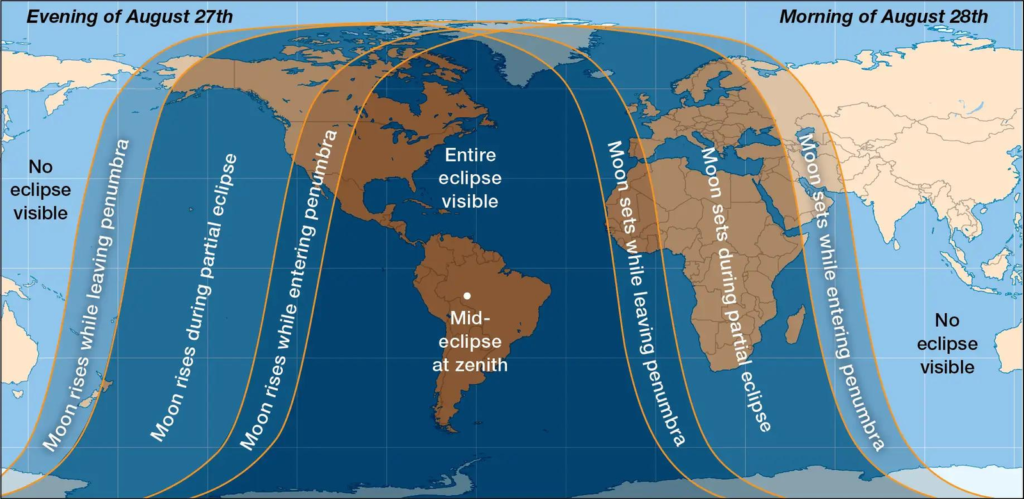
The best viewing opportunities will be across North and South America, while parts of Europe and western Africa will also see the eclipse. Space.com reports that the event could be visible to billions of people, depending on local conditions and which phases occur above the horizon.
For observers in India, the situation is less favorable. The eclipse will not be visible from India because the relevant stages occur when the region is on the daylight side of Earth.
No Special Eye Protection Needed
Unlike a solar eclipse, a lunar eclipse can be viewed safely with the naked eye. The Moon is simply reflecting sunlight rather than producing its own intense light.
Binoculars or a telescope can nevertheless make the event more impressive by revealing details of the Moon’s surface as Earth’s shadow moves across it.
For photographers, the eclipse also offers an opportunity to capture the contrast between the illuminated portion of the Moon and the copper-colored region inside the shadow.
Why This Eclipse Is Special
The August eclipse is notable because it comes remarkably close to totality. With more than 96% of the Moon entering Earth’s umbra, observers may see a large portion of the lunar surface become dark and reddish while a thin region remains brightly illuminated.
It is also part of an unusually active year for skywatchers. August has already delivered a major total solar eclipse, and the upcoming lunar eclipse provides another opportunity to observe how the Sun, Earth and Moon align in space. NASA notes that eclipses occur during specific “eclipse seasons,” when the three bodies line up closely enough for Earth’s or the Moon’s shadow to fall across the other body.
A Near-Total Lunar Spectacle
The August 27–28 event demonstrates how even a partial eclipse can produce a spectacular astronomical display. With only a small fraction of the Moon remaining outside Earth’s darkest shadow, the event is expected to resemble a total lunar eclipse while offering scientists and skywatchers a different geometry to study.
For astronomy enthusiasts, it is a reminder that some of the most impressive sights in the night sky require no spacecraft or sophisticated observatory—just the right alignment of the Sun, Earth and Moon.