
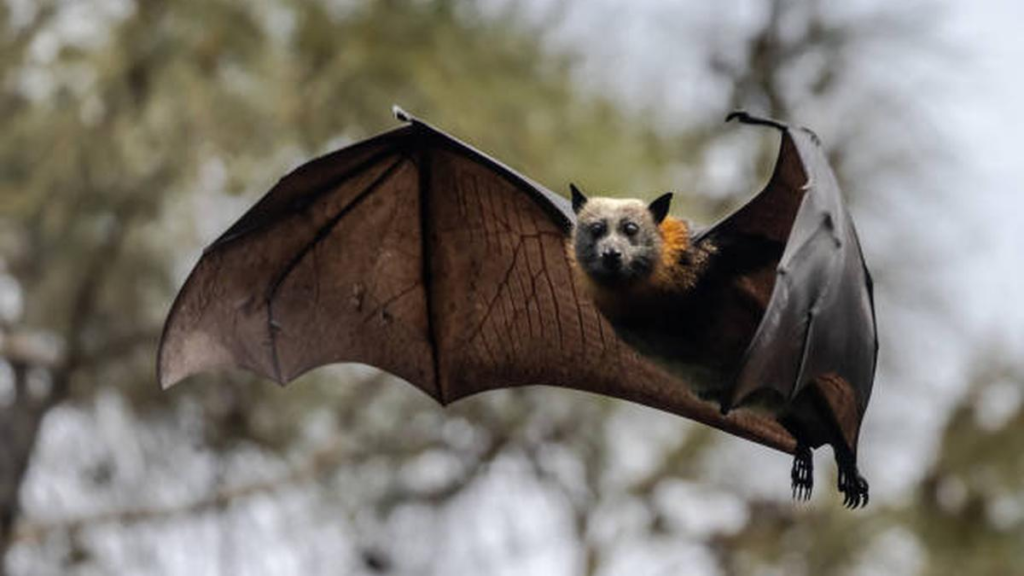
A major new study has offered a fresh explanation for one of the biggest questions in bat evolution: where did the world’s only naturally flying mammals first emerge?
Researchers now suggest that bats most likely originated in Europe around 65 million years ago, during the Late Palaeocene. The finding challenges earlier theories that placed their origins in regions including Africa, Asia or North America.
A Much Larger Look at Bat Evolution
The research, published in Nature, combined genetic information and fossil evidence on an unusually large scale. Scientists analysed high-quality genomes from 103 bat species representing all 21 living bat families, alongside information from 44 fossil bats.
This combination allowed researchers to reconstruct relationships between ancient and modern bat groups more comprehensively than earlier studies.
Europe Emerges as the Likely Birthplace
According to the study’s biogeographical analysis, the common ancestor of bats most likely lived in Europe during the Late Palaeocene, about 65 million years ago.
The researchers estimate a 99.2% posterior probability for Europe as the ancestral range in their model. From there, early bat lineages appear to have expanded into Africa and later reached other parts of the world.
Flight Was Already Part of the Early Story
Bats are unique among living mammals because they evolved powered flight. The new research suggests that their origin in Europe also represents the early history of mammalian flight.
The fossil record shows that bats were already capable of powered flight by the early Eocene, roughly 56–52 million years ago. The new analysis helps connect those fossils with a broader evolutionary history.
Echolocation May Be Nearly as Ancient
The study also provides clues about another defining bat ability: echolocation.
Researchers placed the fossil bat Vielasia within an early bat lineage that appears to have possessed laryngeal echolocation. This suggests that echolocation developed very early, before the diversification of modern crown-group bats.
How Scientists Solved the Mystery
Bat evolution has been difficult to reconstruct because the fossil record is incomplete and bats spread rapidly across continents after developing flight.
To address this, researchers combined genome data, fossil characteristics and geographical modelling. The study used 103 genomic assemblies and a morphological dataset covering 699 characteristics from living and extinct bats.
This broader evidence helped researchers reassess earlier conclusions about where bats originated.
A New Chapter in Bat Evolution
The findings provide a revised picture of how bats may have spread across the planet. After their early history in Europe, different lineages expanded into Africa, Asia, the Americas and Australia as bats diversified.