
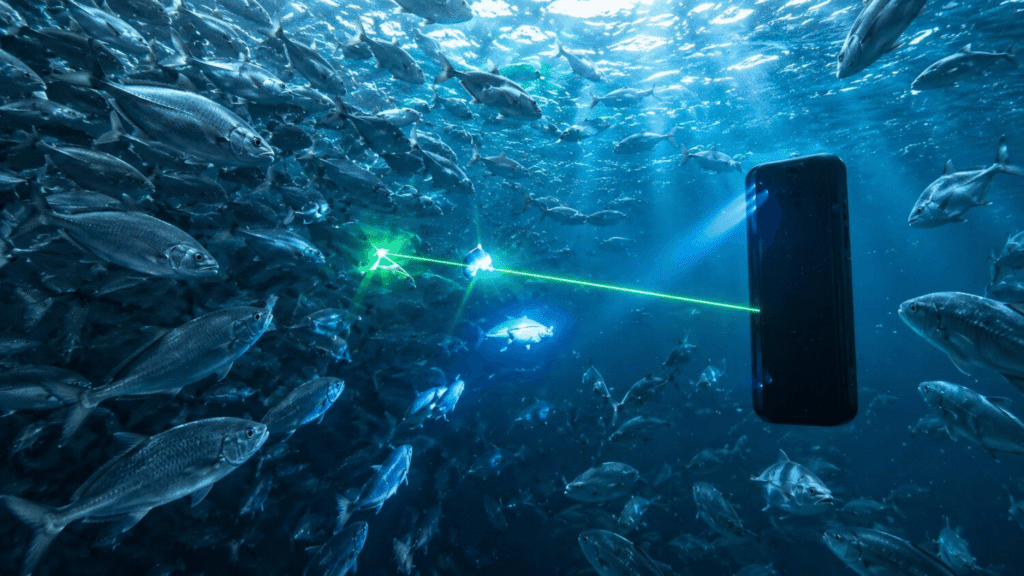
Norway is using an unusual combination of artificial intelligence, underwater robotics and laser technology to tackle a major problem in its fishing industry. More than 3,500 AI-guided underwater robots are now operating around salmon farms along the Norwegian coast, identifying and eliminating tiny parasites known as sea lice.
The technology, developed by Oslo-based company Stingray Marine Solutions, is designed to protect farmed salmon without relying heavily on traditional chemical treatments. According to the company’s latest annual report, the systems are protecting more than 112 million fish, making this one of Scandinavia’s largest commercial applications of AI-powered robotics.
How Do the Underwater AI Robots Work?
The underwater systems use cameras, artificial intelligence and specialised lasers to identify sea lice attached to salmon.
The robots continuously monitor fish swimming inside aquaculture pens. Once the AI-powered cameras detect a parasite, the system directs a laser towards it to eliminate the sea louse without deliberately harming the fish.
The technology is known as optical delousing. It allows salmon to remain in their farming environment while the robots carry out their work around the clock.
Some systems also use specialised lighting to improve visibility and help cameras distinguish parasites from the fish.
Why Are Sea Lice a Serious Problem?
Sea lice are tiny parasitic crustaceans that attach themselves to fish and feed on their skin and tissues. They are among the biggest challenges facing commercial salmon farming.
Large infestations can damage fish, affect their growth and increase the risk of disease. Controlling these parasites is therefore important for both the fishing industry’s productivity and animal welfare.
Traditional treatment methods include chemical baths and other interventions that can require handling and moving large numbers of fish. Such procedures may cause stress, while some chemical treatments can create environmental concerns.
Sea lice can also develop resistance to certain treatments, making long-term control more difficult.
More Than 3,500 Robots Protect 112 Million Fish
Stingray Marine Solutions has significantly expanded its operations in recent years. Its latest reported figures indicate that more than 3,500 underwater units are deployed across Norwegian salmon farms.
The systems reportedly protect over 112 million fish, covering approximately 20–25 per cent of Norway’s farmed salmon population.
The company has also expanded its monitoring infrastructure, using thousands of cameras to collect information from fish farms along the coast.
This continuous stream of information helps operators monitor parasite activity and assess fish health more effectively.
An Alternative to Chemical Treatments
One of the biggest advantages of laser-based delousing is its ability to target parasites individually.
Unlike chemical baths, which can involve treating large groups of fish, the robotic systems identify sea lice and direct their lasers towards specific targets.
This approach could reduce the need for repeated chemical treatments and some forms of physical handling. It may also help minimise the environmental impact associated with certain conventional methods.
The technology is particularly useful as a preventive measure, helping farmers keep parasite populations under control before infestations become severe.
However, claims about improved fish welfare and reduced mortality are largely based on company-reported results and require further independent assessment.
What Are the Limitations of the Technology?
Despite its potential, the system has some practical challenges.
The initial investment required to install and operate thousands of underwater units may be expensive for smaller fish-farming businesses.
The robots also have a limited operating range because they are deployed inside specific salmon pens. Parasites located in darker or less accessible areas may escape detection.
This means the technology may not completely eliminate the need for other parasite-control methods. Farmers may still require additional measures when infestations spread beyond the robots’ effective monitoring areas.
AI Is Changing the Future of Aquaculture
Norway’s experiment demonstrates how artificial intelligence is moving beyond conventional applications such as chatbots, image generation and automated office tasks.
AI-powered systems are increasingly being used in agriculture, fisheries, industrial monitoring and environmental management.
In salmon farming, underwater cameras and automated systems can help operators identify problems earlier and make decisions using real-time information.
The technology could also encourage other countries with large aquaculture industries to explore similar approaches.
A New Direction for Sustainable Fish Farming
The deployment of thousands of laser-equipped underwater robots represents an important development in commercial aquaculture. It combines computer vision, robotics and precision technology to address a longstanding challenge in fish farming.
Although installation costs and operational limitations remain, the approach offers an alternative to conventional parasite-control methods.
If independent research continues to demonstrate reliable results, AI-powered underwater systems could become an increasingly important part of sustainable fish farming around the world.