
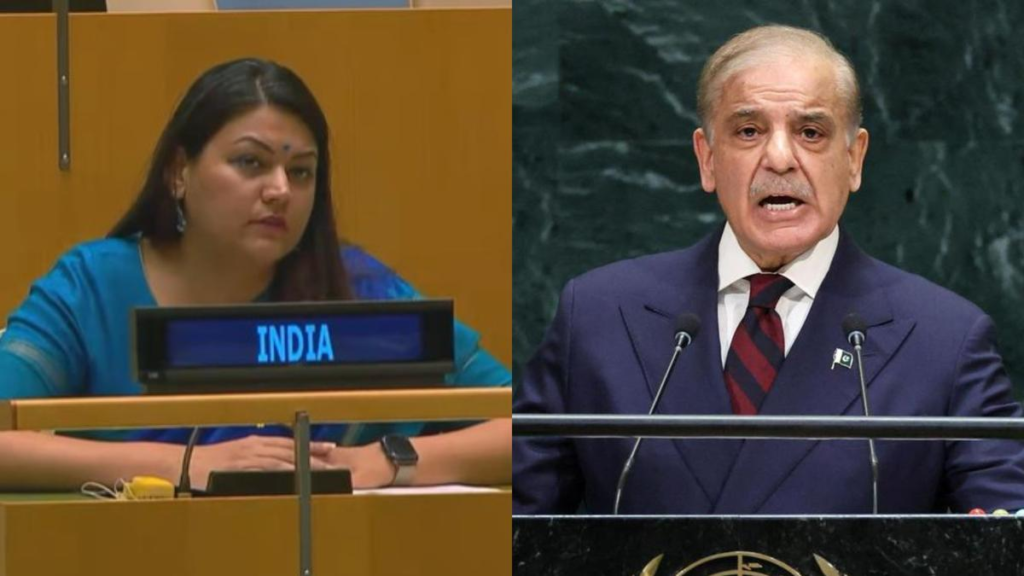
India and Pakistan faced off diplomatically at the United Nations after Pakistan Prime Minister Shehbaz Sharif raised issues including Jammu and Kashmir and the Indus Waters Treaty during his address to the UN General Assembly.
Responding through India’s Right of Reply, First Secretary at India’s Permanent Mission to the UN, Petal Gahlot, rejected Pakistan’s statements and focused on New Delhi’s concerns over cross-border terrorism.
India Challenges Pakistan’s UN Remarks
Gahlot said Pakistan’s claims about India did not reflect New Delhi’s position on Jammu and Kashmir and other bilateral issues. She reiterated India’s long-standing position that Jammu and Kashmir is an integral part of the country.
She also referred to Pakistan-occupied Jammu and Kashmir and raised concerns about reported violence and rights issues there.
Terrorism Remains Central to India’s Response
A major part of India’s response centred on terrorism. Gahlot said Pakistan should take action against terrorist infrastructure and argued that India retains the right to defend itself against cross-border attacks.
She warned that continued terrorism would have consequences, making the issue a central point of India’s response at the UN.
India Raises Osama bin Laden Reference
During her statement, Gahlot referred to Osama bin Laden, the al-Qaeda leader who was found in Abbottabad, Pakistan, in 2011.
She used the reference while challenging Pakistan’s claims on security and its criticism of India, arguing that the history of terrorism in the region should be considered when discussing security at the international level.
Pakistan Had Raised Kashmir and Water Issues
Sharif’s UN address included criticism of India’s position on Jammu and Kashmir and the Indus Waters Treaty. Pakistan has separately maintained that any attempt to stop or divert its share of river waters would be viewed seriously.
India’s response came in the formal Right of Reply following the Pakistani leader’s address, turning the UN platform into another setting for the two countries to present sharply different positions on their bilateral disputes.
India Defends Its Position on Self-Defence
Gahlot said India would continue to exercise its right to protect itself against terrorism. Her remarks linked the issue of cross-border terrorism with India’s broader national-security position.
India has consistently raised terrorism as a key concern in its engagement with Pakistan and at international forums. The Ministry of External Affairs has previously stated that India seeks normal relations with Pakistan in an environment free from terror, violence and hostility.
Diplomatic Tensions Continue
The exchange at the UN highlights the continuing differences between New Delhi and Islamabad over Kashmir, terrorism and water-related issues.
For India, stopping cross-border terrorism remains a central condition in its stated approach to relations with Pakistan. Pakistan, meanwhile, continues to raise Kashmir and water issues at international forums.
The latest exchange shows that despite diplomatic engagement through multilateral institutions, fundamental disagreements between the two neighbours remain unresolved.