
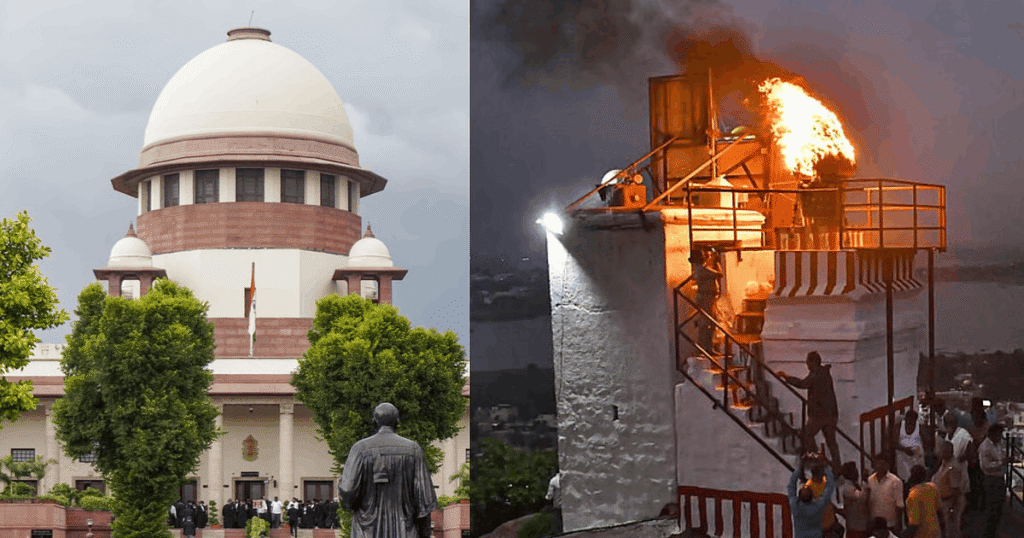
The Supreme Court has issued fresh directions in the Thiruparankundram Deepathoon dispute in Madurai after raising serious concerns over the non-implementation of its earlier order concerning the Karthigai Deepam lamp.
During the November 27 hearing, the court questioned the failure to light the ceremonial lamp on the stone pillar atop the hill, as permitted by its earlier order. Solicitor General Tushar Mehta, appearing for the Archaeological Survey of India, described the alleged non-compliance as aggravated contempt.
Temple Board Suspended, Receivers Appointed
The bench suspended the board of trustees of the Arulmigu Subramaniaswamy Temple and appointed former Madras High Court judges S Vaidyanathan and V Parthiban as receivers to oversee the temple’s administration.
The court also directed the Central Reserve Police Force to provide security at the hill and ordered that the lamp be lit at the Deepathoon on November 28. Safeguards were included for the nearby Sikandar Badusha Dargah.
Senior Officials Asked to Explain
The Supreme Court issued show-cause notices to senior Tamil Nadu government and temple officials, including the Chief Secretary, Director General of Police, Madurai District Collector and members of the temple’s board.
The Chief Secretary was directed to submit an affidavit explaining the sequence of events and provide relevant official communications and emails.
Dispute Over the Lamp’s Location
The controversy intensified after the lamp was lit at the customary Deepa Mandapam near the Uchipillaiyar temple instead of the hilltop Deepathoon. Petitioners argued that the earlier court direction had not been followed, while the state authorities and temple administration maintained that the traditional location should be observed.
The court also questioned a preliminary report by Madurai District Collector Nishant Krishna, which attributed the failure to the temple trustees.
The latest directions have added to the legal and administrative tensions surrounding the dispute. The contempt proceedings remain subject to further consideration, and the court’s observations should not be treated as a final finding of contempt.