
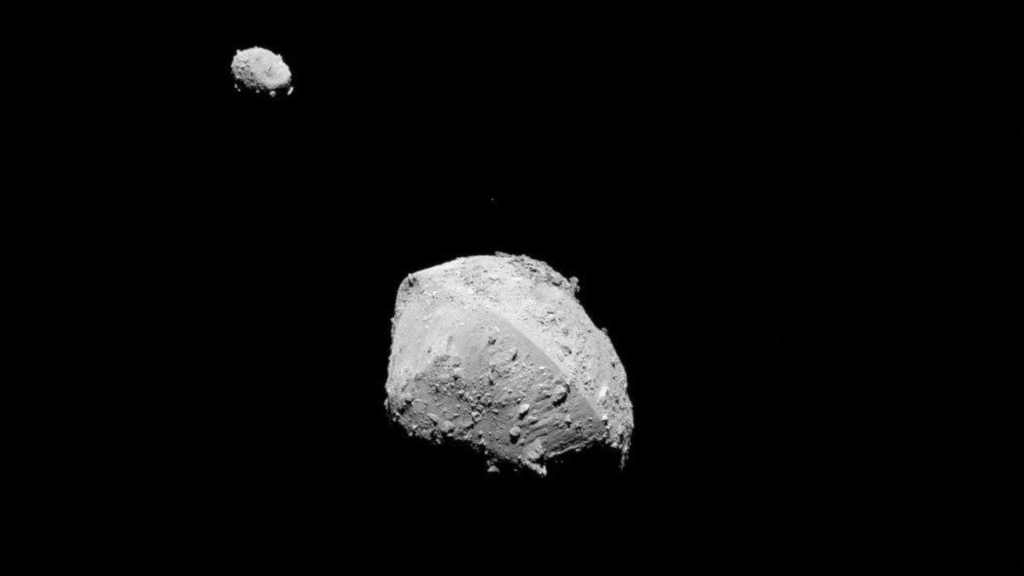
A spacecraft deliberately crashing into an asteroid may sound like science fiction, but it was part of a real planetary defence experiment conducted by NASA in 2022. Now, new images captured by the European Space Agency’s (ESA) Hera spacecraft have revealed the dramatic changes caused by that collision.
The photographs show a massive, stadium-sized crater covering almost the entire impacted face of Dimorphos, a small asteroid orbiting a larger space rock called Didymos. Scientists have also discovered that the collision changed the asteroid’s shape and left it rotating in an unusual, chaotic manner.
The findings offer important information about whether deliberately striking an asteroid could one day help protect Earth from a potentially dangerous space object.
What Happened During NASA’s DART Mission?
On September 26, 2022, NASA carried out its Double Asteroid Redirection Test (DART), deliberately sending a spacecraft into Dimorphos.
The mission was designed to test whether a spacecraft travelling at high speed could change an asteroid’s movement through a controlled collision. Dimorphos, measuring approximately 151 metres across, was selected as the target because it orbits the larger asteroid Didymos.
The spacecraft struck Dimorphos at a speed of around 22,530 kilometres per hour. The impact successfully shortened the smaller asteroid’s orbital period around Didymos by approximately 33 minutes, demonstrating that a kinetic impact could alter an asteroid’s motion.
New Images Reveal a Massive Impact Crater
The latest observations from Hera have provided scientists with a much clearer picture of what happened when DART hit the asteroid.
The impact appears to have flattened one side of Dimorphos, creating a crater so large that it extends across almost the entire width of the asteroid. Researchers say the result is more dramatic than they had anticipated.
Interestingly, the opposite side does not show evidence of similarly extensive changes. This contrast is helping scientists understand how the asteroid responded to the force of the collision.
Asteroid Now Rotates in a Chaotic Manner
Another important discovery concerns Dimorphos’s movement.
Before the collision, the smaller asteroid was tidally locked with Didymos, meaning it kept approximately the same side facing its larger companion. Following the DART impact, however, Dimorphos began tumbling chaotically.
Understanding this change is important because an asteroid’s shape, internal structure and rotation can influence how it responds to a future deflection attempt.
Hundreds of Boulders Discovered Around the Asteroid System
Hera’s observations have also revealed hundreds of previously unidentified boulders surrounding the Didymos-Dimorphos system.
Some of these rocks are several metres across. Their presence adds another layer to the investigation, as scientists must account for the surrounding debris while planning closer observations.
The discovery could also help researchers understand how material was displaced during the collision and how debris behaves around small asteroids.
What Is ESA’s Hera Mission Studying?
Launched in October 2024, Hera was sent to examine the aftermath of NASA’s DART experiment. While DART demonstrated that a spacecraft could change an asteroid’s orbit, Hera is investigating the physical consequences of the collision.
The spacecraft is studying the asteroid pair using cameras and other scientific instruments. Its observations will help researchers examine the crater, surface features and the internal structure of the asteroids.
The mission also plans to deploy two small CubeSats to investigate the asteroid system more closely, including probing its interior.
Could This Technology Protect Earth From Asteroids?
The DART experiment was an important milestone in planetary defence. It demonstrated that a spacecraft can change the movement of a small asteroid through a deliberate impact.
However, scientists need more information before this technique can be considered a dependable solution for every potential asteroid threat. Different asteroids have different sizes, compositions and internal structures, meaning the same impact could produce different results.
Neither Dimorphos nor Didymos poses a threat to Earth. The purpose of studying them is to prepare scientists for a future situation in which an asteroid might be identified on a dangerous collision course with our planet.
The latest images from Hera mark an important step in understanding how asteroid deflection works. By learning exactly what happened to Dimorphos, scientists hope to make future planetary defence missions more effective and predictable.