
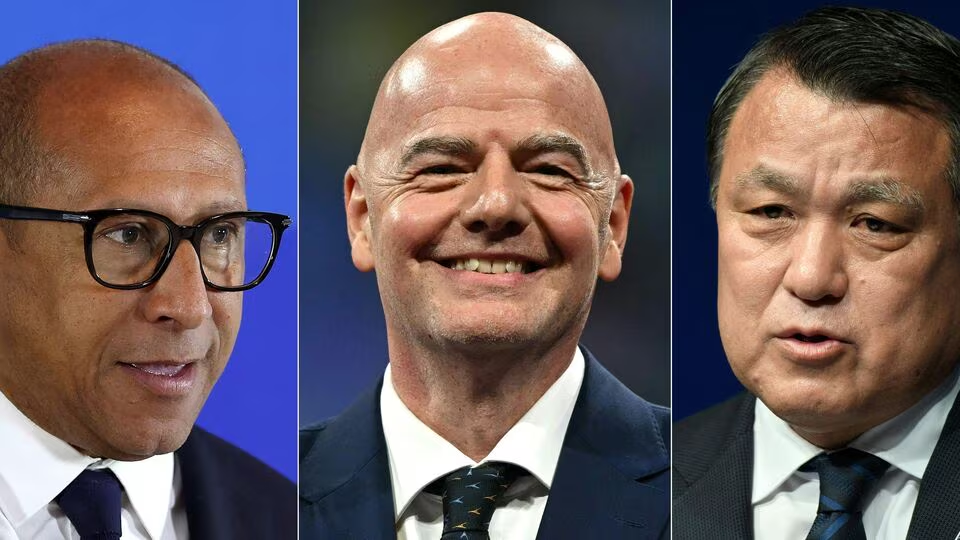
FIFA president Gianni Infantino is preparing for a contested re-election battle as two prominent football administrators, Philippe Diallo of France and Kozo Tashima of Japan, emerge as challengers for the organisation’s top position.
The election, scheduled for March 18, 2027, in Rabat, Morocco, could become an important moment for the future leadership and governance of world football.
Infantino, who has led FIFA since 2016, is seeking another four-year term. However, criticism surrounding his administration and recent commercial proposals has created an opportunity for opposition candidates to present alternative approaches.
1. Gianni Infantino Seeks Another Term as FIFA President
Gianni Infantino became FIFA president in February 2016, succeeding Sepp Blatter following a major corruption scandal that shook international football.
During his leadership, FIFA introduced several significant changes, including expanding the men’s World Cup from 32 to 48 participating teams for the 2026 tournament.
His administration also oversaw the introduction of the expanded FIFA Club World Cup and increased development funding for member associations.
However, his leadership has attracted criticism over governance and commercial decisions. A proposal involving private investment in FIFA’s commercial operations also generated opposition before being abandoned.
Despite the criticism, Infantino remains a strong contender because of his support among several regional football associations.
2. Philippe Diallo Emerges as Europe’s Challenger
Philippe Diallo, president of the French Football Federation, has emerged as a major challenger to Infantino.
Diallo has considerable experience in football administration, having previously worked with professional football organisations in France before joining the federation’s leadership.
He became FFF president in 2023 and subsequently joined UEFA’s Executive Committee.
His candidacy has received backing from UEFA and several European football associations. His campaign is focused on improving transparency, strengthening institutional governance and rebuilding confidence in FIFA’s administration.
Diallo is positioning himself as an alternative for associations seeking changes in the organisation’s leadership and decision-making structure.
3. Kozo Tashima Enters the Presidential Contest
Japan’s Kozo Tashima is another important challenger in the upcoming election.
A former Japanese international footballer, Tashima later moved into coaching and sports administration. He served as president of the Japan Football Association from 2016 to 2024 and currently holds the position of honorary president.
He has also served on FIFA’s governing council, giving him experience in international football administration.
Tashima has made integrity, fairness and transparency central themes of his campaign. He believes FIFA needs stronger governance and greater accountability.
His decision to remain in the presidential race has also attracted attention because the Asian Football Confederation has already expressed support for Infantino.
4. Tashima Open to Working With Diallo
One of the most interesting developments in the election campaign is Tashima’s willingness to discuss possible cooperation with Diallo.
Although both are competing against Infantino, Tashima has indicated that he does not view the French candidate as an opponent on key governance issues.
He has expressed interest in working together if their discussions lead to a shared approach.
However, Tashima has not announced any decision to withdraw his candidacy. He believes that the election should provide member associations with a genuine opportunity to choose FIFA’s next leader.
The possibility of cooperation between the two challengers could become an important factor in the campaign.
5. FIFA Election Faces Questions Over Governance
The upcoming election comes amid discussions about FIFA’s transparency, commercial strategy and institutional accountability.
Infantino’s proposal to attract private investment into FIFA’s commercial operations generated significant criticism before it was abandoned.
Tashima has argued that FIFA must maintain strong ethical standards and ensure that its financial resources serve the organisation rather than individual leadership interests.
Diallo has also emphasised the importance of collective decision-making and transparent administration.
These issues are likely to remain central as the candidates attempt to convince FIFA’s member associations.
6. When and Where Will the FIFA Presidential Election Take Place?
The election will be held during the 77th FIFA Congress in Rabat, Morocco, on March 18, 2027.
FIFA has 211 member associations, each entitled to participate in the presidential election.
Before the vote, the candidates’ nominations will undergo eligibility and integrity checks. FIFA is expected to announce the final list of approved candidates by February 18, 2027.
The voting process will determine whether Infantino secures another term or whether the challengers can build sufficient support to change the organisation’s leadership.
Conclusion
The 2027 FIFA presidential election is shaping up to be an important contest for international football. Gianni Infantino enters the race with considerable institutional support, while Philippe Diallo and Kozo Tashima are presenting alternative visions focused on governance and transparency.
Whether the challengers can cooperate and attract enough votes remains uncertain. The result could influence FIFA’s leadership, commercial direction and administrative priorities for the next four years.