
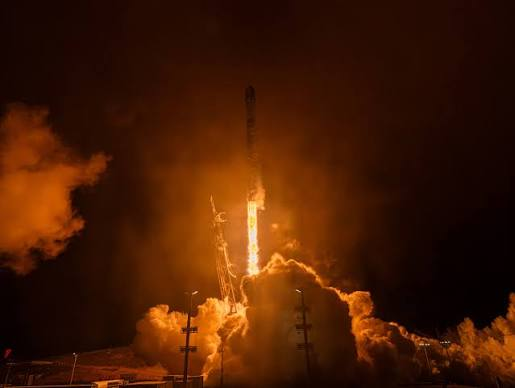
SpaceX has reached another major milestone in its rapidly expanding launch programme, completing its 100th Falcon-family mission of 2026 with the deployment of 27 Starlink satellites into low Earth orbit.
The Falcon 9 lifted off from Vandenberg Space Force Base in California on August 22, carrying the latest batch of Starlink satellites. The mission added another chapter to SpaceX’s unusually high launch tempo this year.
A milestone reached before the year is over
Reaching 100 Falcon-family launches in August highlights how frequently SpaceX is now sending rockets into orbit.
The latest flight was the 99th Falcon 9 mission of 2026. The overall total reached 100 because SpaceX also flew one Falcon Heavy mission earlier in the year.
That distinction is important because the milestone is often described simply as SpaceX’s “100th Falcon launch,” rather than 100 Falcon 9 launches.
27 Starlink satellites head to orbit
The latest Falcon 9 mission carried 27 Starlink satellites, adding another group of spacecraft to SpaceX’s growing broadband network.
After reaching orbit, the satellites joined a constellation that now contains more than 11,000 operational Starlink satellites, according to recent launch reporting. Starlink missions have made up a large share of SpaceX’s launches this year.
The company uses the constellation to provide satellite-based internet services, particularly in areas where conventional ground-based connectivity can be difficult to establish.
The rocket came back after launch
The mission was not only about putting satellites into orbit.
The Falcon 9’s first-stage booster also successfully returned to Earth, landing on the autonomous droneship “Of Course I Still Love You” in the Pacific Ocean roughly eight and a half minutes after liftoff.
The booster, designated B1100, completed its ninth flight. Reusing the same rocket hardware multiple times is one of the central features of SpaceX’s launch strategy.
Why rocket reuse matters
Traditional expendable rockets are generally discarded after a launch. Reusable rockets are designed to return major components so they can be inspected, refurbished and flown again.
SpaceX’s repeated Falcon 9 landings have demonstrated that a booster can perform multiple missions rather than being used just once.
This approach has helped the company maintain a high launch frequency while spreading the cost of rocket hardware across multiple flights.
Starlink is driving much of the launch activity
The latest milestone also shows how closely SpaceX’s launch business is connected to Starlink.
Of the Falcon 9 missions conducted in 2026 so far, a substantial majority have been dedicated to expanding the Starlink network. Recent reporting counted 76 of the year’s 99 Falcon 9 flights as Starlink missions by the time of the August 22 launch.
That means the company’s launch infrastructure is being used not only to serve outside customers but also to build and maintain its own satellite network.
A growing network in low Earth orbit
Starlink satellites operate in low Earth orbit, much closer to the planet than traditional geostationary communications satellites.
Operating closer to Earth can help reduce communication delays, while a large constellation allows coverage to be distributed across many satellites.
But building such a network requires a continuous stream of launches because satellites eventually need to be replaced, upgraded or repositioned.
What comes next for SpaceX?
The 100-mission milestone is unlikely to represent the end of SpaceX’s ambitious launch schedule for 2026.
The company is continuing to prepare additional Falcon 9 missions, while its larger Starship programme is being developed for future high-capacity launches.
SpaceX has also outlined plans for a much larger next-generation Starlink network, which would require a substantial increase in launch capacity.
More than just a launch record
SpaceX’s latest milestone is significant because it illustrates how rapidly commercial spaceflight is changing.
Launching 100 Falcon-family missions in less than eight months would have been extraordinary in the era when rockets were largely treated as single-use vehicles. Today, reusable boosters, automated landing systems and mass-produced satellites are allowing one company to operate at a very different scale.
The latest Starlink mission therefore represents more than 27 additional satellites in orbit. It demonstrates how reusable rockets and large satellite constellations are reshaping the economics and pace of access to space.
And with more Falcon missions still expected before the end of 2026, SpaceX’s launch record could continue to climb well beyond the 100-mission milestone.