
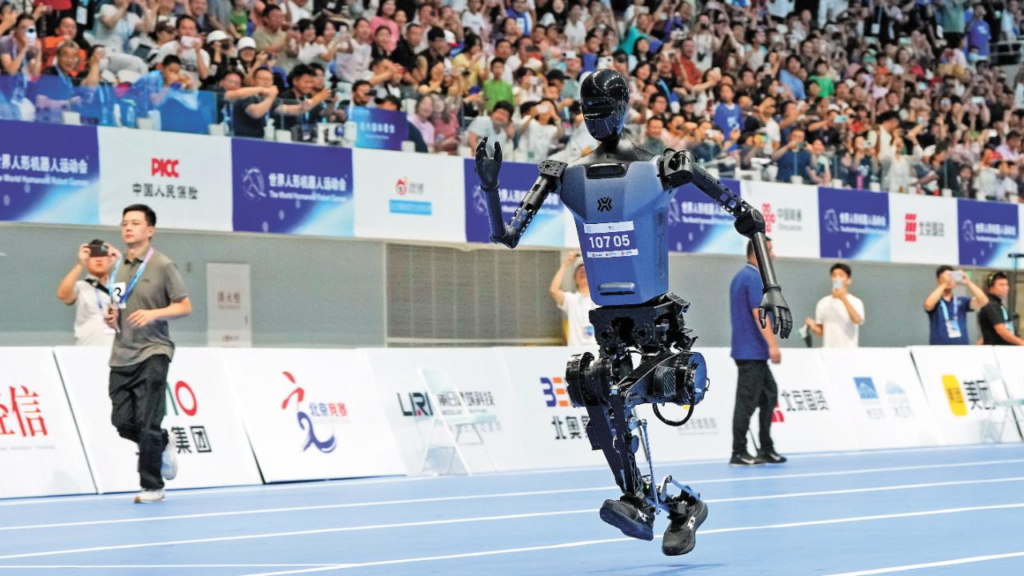
Humanoid robots have moved from laboratory demonstrations to a very different kind of proving ground: the sports arena.
At the 2026 World Humanoid Robot Games in Beijing, Chinese-built humanoid robots delivered remarkable performances in sprinting and jumping, including results that surpassed long-standing human athletics records. The event features more than 2,000 robots competing across 51 events, ranging from running and football to table tennis and other physical challenges.
But the most interesting part of the competition is not simply that robots are getting faster. It is what these performances reveal about the rapid development of robotic balance, motors, sensors and AI-controlled movement.
A Humanoid Robot Runs Faster Than Usain Bolt’s Record
One of the biggest headlines came from the 100-metre sprint.
A humanoid robot developed by Beijing-based X-Humanoid completed the race in 9.39 seconds, beating Jamaican sprinter Usain Bolt’s human world record of 9.58 seconds, set in 2009. Another humanoid robot, Lightning, also reportedly finished under the human record at 9.47 seconds.
The achievement is particularly notable because running on two robotic legs requires constant adjustments to maintain balance while generating enough force to accelerate.
However, these robot performances should not be interpreted as a direct replacement for human athletic records. The machines compete under different physical conditions and are engineered specifically for mechanical performance. The comparison is primarily a striking demonstration of how quickly humanoid robotics is advancing.
The High Jump Record Was Even More Dramatic
Running was not the only event where robots surprised spectators.
A humanoid robot reached 2.88 metres in a standing high jump, surpassing the human men’s high-jump record of 2.45 metres. The robot was again developed by X-Humanoid.
Compared with last year’s humanoid competition, the improvement is particularly striking. The previous best humanoid standing high jump was reported at just 0.95 metres.
Such progress demonstrates how quickly engineers are improving the ability of robots to generate explosive movements while coordinating multiple joints simultaneously.
Speed Is Only One Part of the Challenge
The spectacular numbers come with an important caveat.
Some of the robots have struggled with what happens after they finish running.
At high speeds, stopping a humanoid machine can be extremely difficult. Reports from the event describe robots crashing into padded barriers or falling after crossing the finish line.
That highlights a fundamental challenge in robotics: being fast is useful, but being able to accelerate, slow down, turn, recover from mistakes and remain stable is just as important.
For robots intended to work around people, control and reliability may ultimately matter more than headline speed.
From the Sports Track to Real-World Jobs
This is where the Beijing competition becomes more interesting from a technology perspective.
The event is not limited to athletic demonstrations. Robots are also being tested in scenarios designed to resemble real-world environments, including industrial work, services and emergency situations. Reuters reported that more than 40% of some scenario-based tests require robots to operate autonomously.
Tasks such as plugging in cables, recognising objects, aligning components and recovering from errors may sound less spectacular than a 100-metre sprint—but they are much closer to the challenges robots will face in factories, warehouses and workplaces.
A robot that can run extremely fast but cannot reliably pick up an object or recover after making a mistake still has a long way to go before becoming a practical worker.
Why China Is Investing So Heavily in Humanoid Robots
The games also demonstrate China’s growing ambitions in humanoid robotics.
More than 2,000 robots from hundreds of teams and 16 countries are taking part in the 2026 event. The competition is being held alongside the World Robot Conference in Beijing, where thousands of robotic products are being showcased.
China has increasingly identified humanoid robots as an important emerging technology, with companies working on machines for manufacturing, logistics, services and other applications.
The country’s large manufacturing base could also provide an important advantage: robots that are successfully developed can potentially be tested and deployed in industrial environments at scale.
AI Is Making Robots More Capable
Modern humanoid robots are not simply mechanical machines.
They combine motors and actuators with cameras, sensors, processors and increasingly sophisticated AI systems. These technologies allow robots to understand their surroundings, maintain balance and adjust movements in response to changing conditions.
Athletic competitions provide engineers with a controlled environment for measuring these capabilities.
A faster sprint, higher jump or more stable landing can reveal whether improvements in hardware and control software are actually translating into better physical performance.
The Bigger Question: When Will Robots Become Truly Useful?
The Beijing games show that humanoid robots can already perform some extraordinary physical feats.
But the next major milestone may not be another speed record.
The more important achievement will be a robot that can work for hours, handle unexpected situations, safely interact with people and complete complicated tasks without constant human supervision.
That is a much harder challenge than running 100 metres.
The current generation of humanoids is therefore best viewed as a technology still moving rapidly from experimental demonstrations toward practical deployment. The spectacular records provide evidence of what the machines can potentially do—but their ability to function reliably in everyday environments will determine how important humanoid robots ultimately become.
For now, China’s robot games offer a fascinating glimpse into that future: machines that can already outrun some human records, but are still learning how to master the far more complicated world beyond the finish line.