
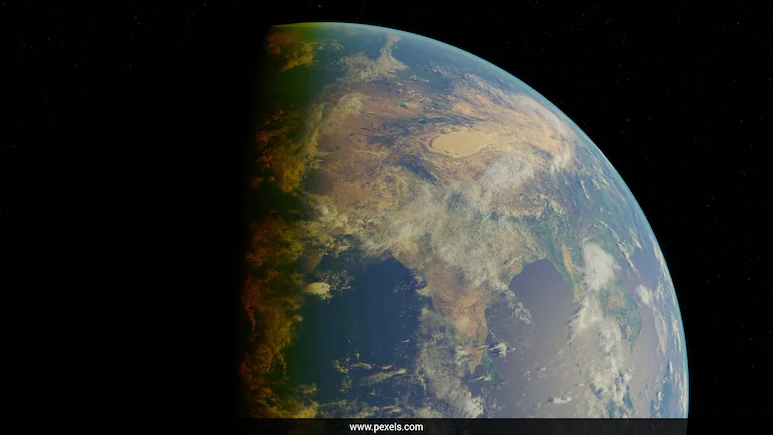
Earth is the only planet currently known to support life, but scientists believe some worlds elsewhere in the universe could offer even more favourable conditions for living organisms. These hypothetical planets, known as superhabitable worlds, could have stable climates, abundant water and more time for life to evolve.
Researchers are increasingly looking beyond planets that resemble Earth to understand whether other environments could be even better suited to life.
What Are Superhabitable Worlds?
Superhabitable planets are hypothetical worlds that may provide conditions more favourable to life than those found on Earth. Researchers have suggested that some could be slightly larger than our planet, with greater mass and environments capable of supporting extensive ecosystems.
Their stronger gravity might help them retain thicker atmospheres, while suitable temperatures and abundant liquid water could create favourable conditions for biological activity. However, these characteristics remain theoretical, and no planet has been confirmed to be more habitable than Earth.
Why Slightly Larger Planets Could Be Better
Some scientists propose that rocky planets around 20–30% wider than Earth could have advantages for life. Greater mass might help these worlds maintain their atmospheres and retain internal heat for longer, depending on their composition and geological history.
Researchers also imagine planets with extensive shallow seas, islands and diverse aquatic environments. Such habitats could potentially support rich ecosystems, although their actual suitability would depend on many factors.
Could Orange Stars Offer Better Conditions?
Scientists are particularly interested in planets orbiting K-dwarf stars, which are smaller and cooler than the Sun and appear more orange in colour.
These stars consume their fuel more slowly and can remain stable for tens of billions of years. This could give life on orbiting planets a much longer period in which to emerge and evolve.
Laboratory experiments using light designed to mimic a K-dwarf star have also explored how plants respond to different stellar conditions. Such experiments can help scientists investigate photosynthesis beyond Earth, but they do not prove that life exists on planets orbiting these stars.
Why Earth May Not Remain Habitable Forever
Earth has supported life for billions of years, but its habitability will not last indefinitely. As the Sun gradually becomes brighter, Earth’s climate is expected to change over geological timescales.
Scientists estimate that Earth could become unsuitable for complex life hundreds of millions of years from now. Planets orbiting longer-lived stars might have more time to support biological evolution, provided they also maintain the right environmental conditions.
How Scientists Plan to Search for These Planets
Astronomers are developing and using advanced telescopes to identify planets outside our solar system, known as exoplanets. They can then investigate factors such as planetary size, temperature, atmosphere and the type of star each planet orbits.
The European Space Agency’s PLATO mission, planned for launch in 2027, is expected to help identify and study potentially interesting planets. Future observations could also examine planetary atmospheres for chemical signatures that might be associated with life.
Finding a potentially habitable planet, however, is only the first step. Establishing whether life actually exists there will require much stronger evidence.
Could Life Exist Beyond Earth?
The idea of superhabitable worlds expands the search for life beyond planets that are close copies of Earth. A world with a longer-lived star, stable environmental conditions and abundant liquid water could potentially provide opportunities for life to develop.
For now, Earth remains the only confirmed living world. Superhabitable planets are an intriguing scientific possibility, and future observations may help researchers determine whether any distant planets offer conditions even more favourable to life