
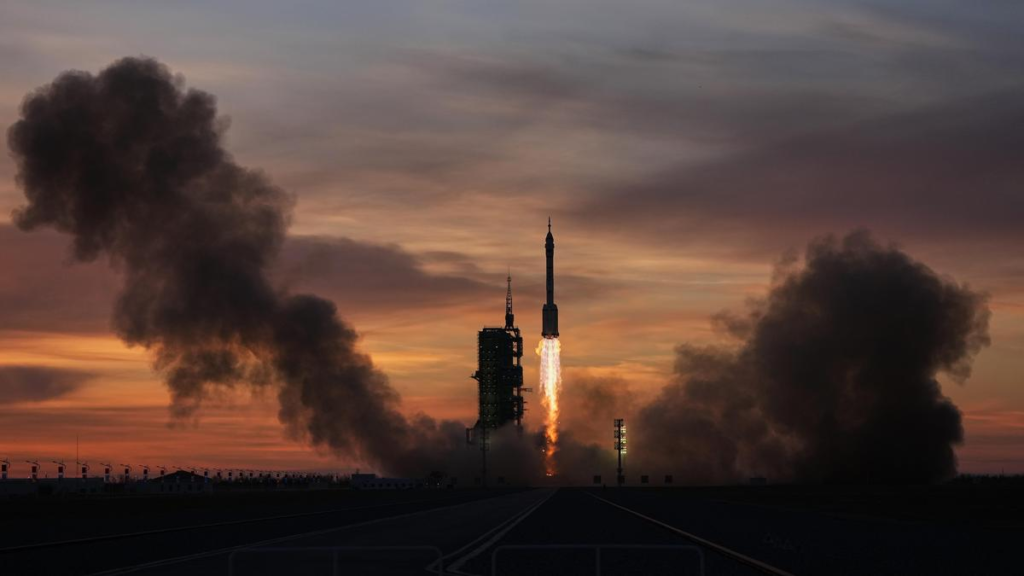
China has achieved a significant milestone in its human spaceflight programme by sending a Pakistani astronaut aboard its Shenzhou-24 spacecraft. The mission, launched on November 25, 2026, marks the first time a foreign astronaut has travelled to China’s Tiangong space station as part of its crewed space programme.
The Pakistani astronaut, Muhammad Zeeshan Ali, travelled alongside two Chinese astronauts, making the mission an important development in China-Pakistan space cooperation.
1. Shenzhou-24 Successfully Launches From China
The Shenzhou-24 spacecraft lifted off from the Jiuquan Satellite Launch Centre in northwestern China at 8:18 am Beijing time on November 25.
A Long March-2F rocket carried the spacecraft into orbit. Following its successful launch, the spacecraft completed its journey to the Tiangong space station, where the crew joined the astronauts already living aboard the orbital facility.
The mission represents the first joint spaceflight involving Chinese and foreign astronauts in China’s crewed space programme.
2. Who Is Muhammad Zeeshan Ali?
Muhammad Zeeshan Ali, a 40-year-old former Pakistan Air Force pilot, has become the first Pakistani astronaut to travel into orbit and the first foreign crew member to board China’s Tiangong space station.
He was selected as a payload specialist for the mission. Before the flight, Ali underwent approximately seven months of specialised training in Beijing.
His preparation included spacecraft operations, emergency procedures, scientific experiments and Chinese-language training to help him communicate with his fellow crew members.
3. Chinese Astronauts Join the Historic Mission
Ali is travelling with two Chinese astronauts, Tang Hongbo and Wu Yi.
Tang Hongbo is the mission commander, while Wu Yi serves as the flight engineer. The mission brings together astronauts from two countries for scientific and operational activities aboard China’s space station.
For Tang, the flight is particularly significant because it marks his third visit to the Tiangong space station.
4. Scientific Experiments Planned During the Mission
The Shenzhou-24 mission includes scientific experiments and technology demonstrations, with several activities involving cooperation between China and Pakistan.
The programme includes research in biotechnology and materials science. Ali is also expected to participate in an experiment involving photosynthetic cyanobacteria, organisms studied for their potential applications in space research.
These experiments are intended to contribute to scientific understanding and the development of technologies that could support future space missions.
5. China-Pakistan Space Cooperation Reaches a New Stage
The mission follows an agreement between China and Pakistan to expand cooperation in human spaceflight.
The two countries have worked together on space-related projects for several decades, including satellite launches and scientific programmes.
China’s decision to include a Pakistani astronaut in its crewed mission represents a new stage in that partnership. Pakistani leaders have also described the flight as a source of national pride and an important achievement for the country’s space programme.
6. What Is China’s Tiangong Space Station?
Tiangong, whose name translates to ‘Heavenly Palace’, is China’s permanently crewed space station. It became fully operational in late 2022 and serves as an orbital laboratory for scientific research and technology development.
The station can accommodate astronauts during crew rotations and supports experiments in areas such as biology, materials science and space medicine.
China is also developing its human spaceflight capabilities with the longer-term objective of sending astronauts to the Moon.
7. A New Opportunity for International Space Collaboration
The Shenzhou-24 mission highlights China’s efforts to expand international participation in its space programme. By sending a Pakistani astronaut to Tiangong, the country has demonstrated that its orbital station can support cooperation beyond its own national astronaut corps.
For Pakistan, the flight is a major milestone in human space exploration. For China, it represents an important step towards building international partnerships in space science.
The mission could also create opportunities for further joint experiments and astronaut exchanges as both countries explore future space projects.