
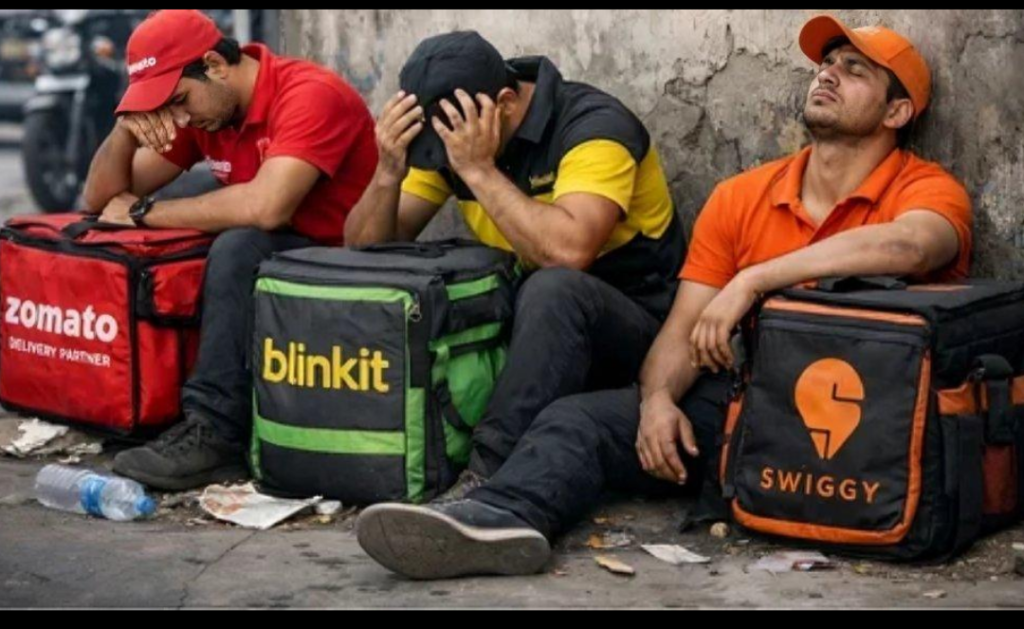
A large share of India’s platform-based gig workers continue to operate without essential insurance cover, according to a recent nationwide survey.
Around 62.2% of platform workers lack health insurance, while 44.2% do not have accident insurance, the report by labour rights organisation Janpahal and the Gig Workers Association (GigWA) has found. The figures closely match earlier estimates highlighting weak social protection for the sector.
Key Findings from the Survey
The study surveyed 1,000 platform workers across 10 cities and painted a picture of high occupational risk combined with limited institutional support:
62.2% reported having no health insurance.
44.2% said they had no accident insurance.
More than 80% of those who tried to claim accident insurance found the process difficult.
59.3% received no safety training or resources from their platforms; another 23.4% said the training was inadequate. Only 7.5% reported comprehensive support.
50% of respondents were not registered on the e-Shram portal, the government’s database for unorganised workers that unlocks access to schemes such as PM-JAY (health cover) and PMSBY (accident insurance).
Workers face elevated risks from road accidents, extreme heat, long hours, and poor working conditions. Nearly two-thirds use their own two-wheelers, with high rates of near-misses, traffic accidents, and injuries linked to road conditions. Many also report fatigue, musculoskeletal pain, stress, and limited access to rest areas, drinking water, or toilets.
The report notes that responsibility for managing occupational risk remains largely individualised. Platforms provide limited institutional support, and linkage to formal social security mechanisms is weak. Non-registration on e-Shram further restricts access to government benefits under the Code on Social Security, 2020, which explicitly includes gig and platform workers.
India’s gig workforce has grown rapidly—estimated at around 1.2 crore workers—and contributes significantly to the economy through food delivery, ride-hailing, quick commerce, and logistics. Yet most still lack the safety net available to formal employees.
While some platforms offer limited voluntary insurance and states such as Tamil Nadu have enhanced accident cover for registered gig workers, coverage remains uneven. The survey underscores the need for stronger enforcement of social security provisions, better awareness of e-Shram registration, simplified claims processes, and improved safety training.
Experts and worker organisations argue that bridging this insurance gap is essential for the long-term sustainability and fairness of India’s platform economy. Without adequate health and accident protection, the workers who power everyday convenience continue to bear disproportionate personal and financial risks.