
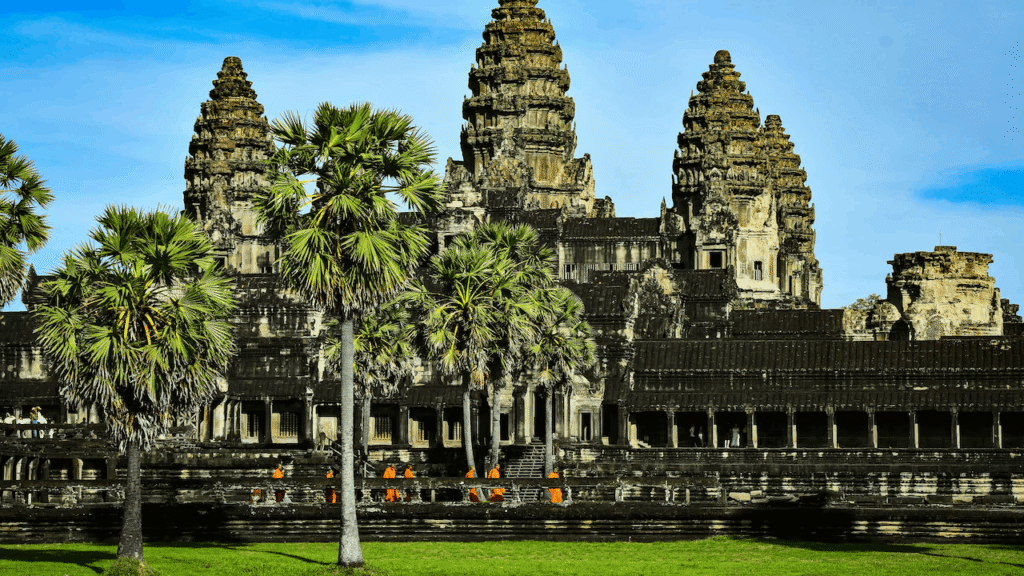
Standing for more than eight centuries, Angkor Wat in Cambodia remains one of the most extraordinary architectural achievements in human history. Known for its enormous scale, intricate stone carvings and remarkable towers, the ancient temple attracts visitors from across the world.
Located near Siem Reap, Angkor Wat is recognised by Guinness World Records as the largest religious structure ever built. Spread across approximately 162.6 hectares, the monument reflects the artistic, architectural and religious achievements of the ancient Khmer Empire.
1. The History Behind Angkor Wat
Angkor Wat was constructed during the 12th century under the rule of Khmer King Suryavarman II, whose reign began in 1113. Construction is generally dated to the period between 1113 and 1150.
The temple was originally dedicated to Lord Vishnu and served as an important centre of Hindu worship. Its name is commonly translated as ‘City of Temples’, reflecting its monumental religious significance.
Over the following centuries, the site gradually developed into an important Buddhist centre and continues to hold religious significance today.
2. Why Angkor Wat Is the World’s Largest Religious Structure
Angkor Wat’s extraordinary size is one of its most remarkable features. Guinness World Records identifies it as the largest religious structure in the world, covering approximately 162.6 hectares, equivalent to around 401 acres.
The monument is surrounded by an enormous moat and a series of galleries, courtyards and stone structures. Its scale demonstrates the engineering capabilities and organisational strength of the Khmer Empire.
The surrounding Angkor archaeological region contains numerous other temples and historic remains, making it an important destination for understanding Cambodia’s ancient civilisation.
3. Five Towers Inspired by Hindu Cosmology
One of Angkor Wat’s most recognisable architectural features is its arrangement of five towers. Four smaller towers surround a taller central tower, creating a distinctive structure visible from a distance.
The design symbolises Mount Meru, which holds a central position in Hindu cosmology as the sacred home of the gods. The surrounding walls and moat represent the mountains and oceans believed to surround the cosmic centre.
This architectural concept gives the monument a deeper religious meaning beyond its impressive physical dimensions.
4. Intricate Stone Carvings and Ancient Stories
Angkor Wat is celebrated for its detailed bas-relief carvings, which cover extensive sections of its galleries. These artworks depict scenes from Hindu mythology, royal processions, battles and episodes from ancient epics.
Stories from the Ramayana and Mahabharata are among the subjects represented in the temple’s artistic decorations.
The carvings provide valuable insight into the religious beliefs, cultural traditions and artistic skills of the Khmer civilisation.
5. From a Hindu Temple to a Buddhist Landmark
Although Angkor Wat was originally built as a Hindu temple dedicated to Vishnu, Buddhism gradually became more prominent in the region.
Over time, Buddhist statues and religious practices became part of the temple’s history. The monument consequently developed into a sacred destination associated with both Hindu and Buddhist traditions.
Its continued religious importance makes Angkor Wat more than an archaeological attraction. It remains a place of worship and cultural identity for Cambodia.
6. A UNESCO World Heritage Destination
Angkor was designated a UNESCO World Heritage Site in 1992. The historic area preserves the remains of several capitals of the Khmer Empire, including temples, reservoirs and other examples of ancient urban planning.
The site is particularly significant for its architecture, artistic achievements and evidence of the Khmer civilisation’s development.
Conservation efforts have played an important role in protecting its structures and carvings from environmental damage and the effects of time.
7. How Travellers Can Visit Angkor Wat
Angkor Wat is located near Siem Reap in northwestern Cambodia. The city serves as the main base for travellers exploring the temple and the wider Angkor Archaeological Park.
Visitors can explore the central temple complex, admire its five towers, walk through its galleries and discover the surrounding historical monuments. Sunrise visits are especially popular because the temple’s silhouette creates a striking reflection across the surrounding water.
Travellers should plan sufficient time to explore the wider archaeological area and follow local visitor guidelines to help preserve the historic structures.
Conclusion
Angkor Wat is a remarkable reminder of the architectural ambition and cultural achievements of the ancient Khmer Empire. More than 800 years after its construction, its enormous scale, religious symbolism and intricate artwork continue to attract global attention. For travellers interested in history, architecture and heritage, this Cambodian landmark remains one of the world’s most extraordinary destinations.