
Astronomers may need to rethink one of the clues they have used to identify some of the universe’s most powerful stellar explosions.
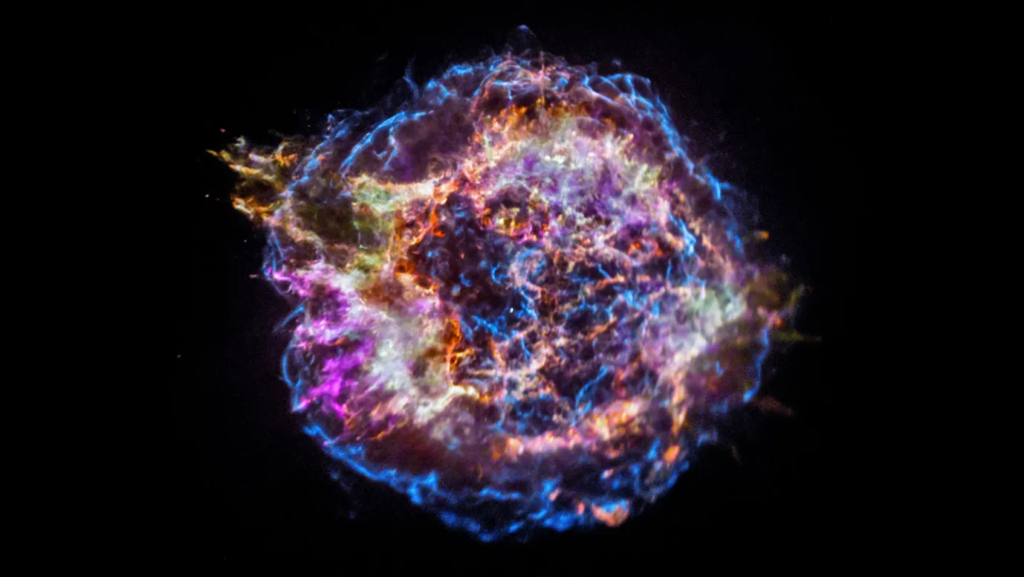
New mathematical modelling suggests that unusual chemical patterns found in some old stars in the Milky Way may not require hypernovas—extremely energetic types of supernova explosions. Ordinary supernovas may be capable of producing similar chemical signatures.
Why Hypernovas Became a Suspect
Astronomers study the elements inside stars to learn about their origins. When an earlier star explodes, it releases material into space, which can later become part of new stars.
Some unusual, metal-poor stars in the Milky Way’s outer halo contain distinctive combinations of elements. Scientists had suggested that these patterns could be evidence of hypernovas because ordinary stellar explosions did not appear to explain them easily.
Supernova Material May Not Mix Evenly
The new research focuses on an important detail: material from a supernova explosion may spread unevenly.
For example, oxygen-rich material could move in one direction while nickel-rich material travels another. If the surrounding gas does not completely mix, stars forming in different locations could inherit very different chemical compositions from the same explosion.
A New Model Challenges the Hypernova Explanation
Researchers developed a mathematical model that accounts for this uneven distribution of elements. Their calculations showed that ordinary, asymmetric supernova explosions could reproduce the chemical patterns observed in some unusual Milky Way stars.
In some cases, the new model matched the observations as well as or better than the previous hypernova explanation.
Hypernovas Have Not Been Ruled Out
The findings do not prove that hypernovas never produced these stars.
Astronomer Anna Frebel of MIT noted that both ordinary supernovas and hypernovas remain possible explanations. The research instead suggests that astronomers should be cautious about treating unusual chemical patterns as unique evidence for a particular type of explosion.
What This Means for Understanding Stars
The study highlights how much information can be hidden in the chemical makeup of ancient stars. Understanding how elements move through space could help astronomers reconstruct the events that occurred before those stars formed.
For now, the debate over hypernovas remains open, but the new work suggests that some cosmic mysteries may have simpler stellar origins than previously thought.