
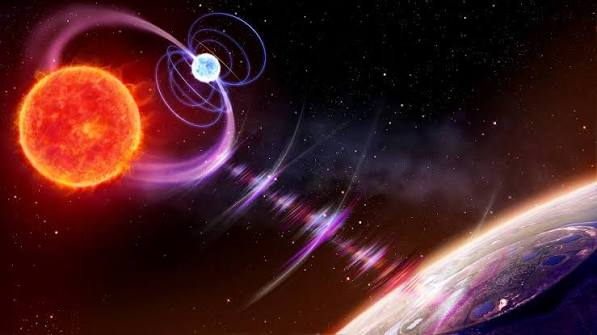
Astronomers have uncovered a fascinating explanation for mysterious radio bursts coming from pairs of stars. New supercomputer simulations suggest that certain white dwarf–red dwarf systems can generate powerful, highly organized beams of radio emission through interactions between their magnetic fields.
The discovery provides a new understanding of a strange type of cosmic radio signal that appears at regular intervals and has puzzled astronomers for years. The research was conducted by scientists at Caltech and published in The Astrophysical Journal Letters.
A Strange Signal From a Stellar Pair
The systems behind these signals contain two very different stars: a white dwarf, the compact remnant of a dead star, and an M dwarf, a small red star.
Astronomers have observed radio bursts from some of these systems repeating over periods of minutes. That timing is unusual because many better-known cosmic radio pulses, such as those from pulsars, occur much more rapidly.
Scientists suspected that the movement of the two stars around each other was responsible, but exactly how their orbital motion produced such intense radio emission remained unclear.
A Cosmic Version of Jupiter and Io
The new simulations reveal that the process has a surprising parallel much closer to home.
Jupiter and its moon Io are known to generate powerful radio emissions because Io moves through Jupiter’s strong magnetic field. This interaction produces an electrical current that can accelerate electrons and create radio waves.
Researchers found that a similar mechanism can operate on a much larger stellar scale in white dwarf–M dwarf systems.
As the two stars orbit one another, their interaction with magnetic fields can generate powerful electrical currents. These currents drive a process known as electron cyclotron maser instability, or ECMI, which produces concentrated radio emission.
Why Scientists Call It a Cosmic Radio Laser
The emission is sometimes described as a kind of cosmic radio laser, although the scientific term is maser.
The process causes electrons to move collectively along magnetic-field lines, producing coherent radio beams. The emission itself can remain active, but Earth detects it as repeating pulses when the beam sweeps across our line of sight.
This helps explain why astronomers see regular bursts even though the underlying radio-producing mechanism may not actually be switching on and off.
Supercomputers Reveal What Telescopes Cannot See
The researchers used detailed numerical simulations to reproduce the physical processes taking place between the two stars.
The simulations indicate that the radio-producing mechanism could be up to 10 times more efficient than previously thought. They also predict that the resulting radio emission should have particular polarization characteristics, giving astronomers another way to test the model through observations.
One of the systems examined in the research is GLEAM-X J0704-37, where observations have linked the unusual radio activity to a white dwarf–red dwarf binary.
A New Window Into Extreme Stellar Physics
The findings do more than explain one unusual type of radio burst. They show that a physical process first studied in the Jupiter-Io system can operate in extreme stellar environments as well.
That connection could help astronomers better understand other mysterious radio sources and develop more accurate models of magnetic interactions between stars.
The study also demonstrates how combining astronomical observations with high-powered computer simulations can reveal invisible processes occurring millions or billions of kilometres away.
As astronomers continue searching the sky for unusual radio signals, these stellar pairs could become important laboratories for studying magnetic fields, plasma and the behavior of matter under extreme cosmic conditions.