
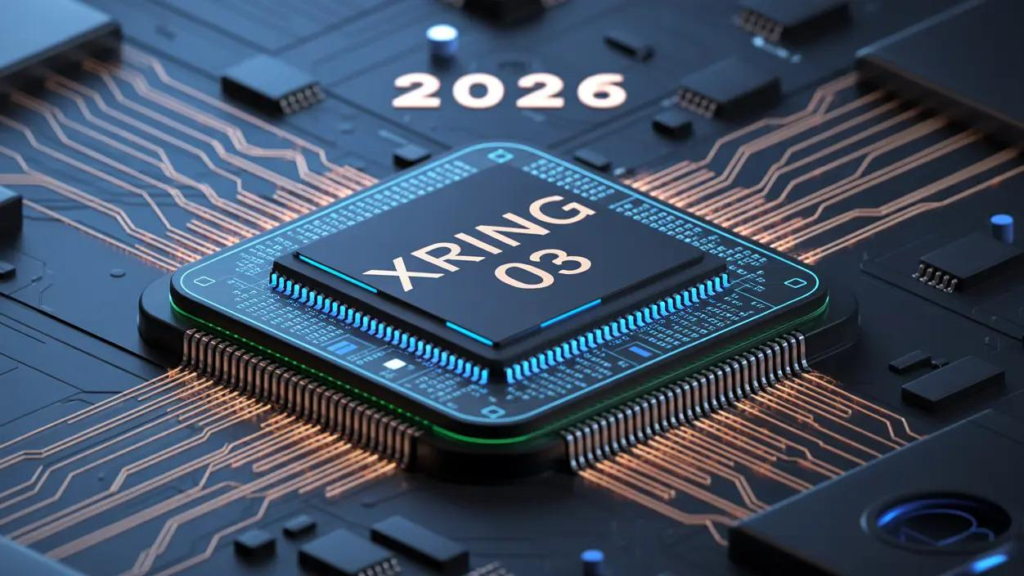
Xiaomi is taking another major step into the semiconductor world with the launch of its new Xring O3 smartphone processor. Unveiled on August 24, 2026, the chip represents the company’s continuing effort to develop more of the technology inside its own devices rather than depending entirely on external processor suppliers.
The move comes only about a year after Xiaomi introduced its first proprietary smartphone processor, the Xring O1. With the O3, the company is moving deeper into the premium smartphone market and reportedly preparing to use the chip in an upcoming flagship foldable device.
Why Xiaomi Is Building Its Own Processors
For years, smartphone manufacturers have relied heavily on companies such as Qualcomm and MediaTek for their main processors. These chips provide the computing power needed for applications, cameras, gaming, artificial intelligence and everyday smartphone functions.
Developing an in-house processor gives a manufacturer greater control over how the hardware works with its software and other components.
For Xiaomi, the Xring programme is therefore about more than creating a faster chip. It is part of a broader strategy to gain greater control over its technology and strengthen its supply chain.
A 3-Nanometre Chip
One of the most notable aspects of the Xring O3 is its reported manufacturing technology.
People familiar with Xiaomi’s plans told Reuters that TSMC will manufacture the processor using a 3-nanometre process. TSMC is one of the world’s leading semiconductor manufacturers, and its advanced production technology is used for some of the industry’s most sophisticated processors.
A smaller manufacturing process can allow manufacturers to fit more transistors into a given area and potentially improve performance and power efficiency. However, the manufacturing node alone does not determine how well a smartphone will perform; chip architecture, software optimisation and thermal design also matter.
The Chip Could Power Xiaomi’s Next Foldable
The Xring O3 is expected to make its way into Xiaomi’s upcoming premium foldable smartphone. Reuters reports that the initial shipment target for the device is expected to be around 200,000 to 300,000 units, based on information from people familiar with the plans. Xiaomi and TSMC had not immediately confirmed those production details.
Choosing a high-end foldable for the chip’s expansion is strategically important. Foldable phones compete in one of the industry’s most premium categories, where manufacturers are trying to combine powerful processors, advanced displays, cameras and artificial intelligence features in increasingly compact designs.
Building on the Xring O1
The O3 is not Xiaomi’s first experiment with custom smartphone silicon.
The company launched the Xring O1 in 2025, and Xiaomi said last week that devices using the processor—including smartphones, tablets and watches—had surpassed one million cumulative shipments. Sources cited by Reuters estimated that around 150,000 smartphones using the O1 had been sold since its May 2025 launch.
That gives Xiaomi an early commercial base from which to develop its next generation of chips.
Xiaomi Is Expanding Beyond Smartphone Silicon
The company’s semiconductor ambitions are also moving into other areas.
Alongside the Xring O3, Xiaomi has introduced the Xring O100, a chip designed for neural processing and AI applications, and the Xring D100, aimed at intelligent-driving systems. Both are expected to move toward commercial applications in 2027.
This suggests Xiaomi is not treating custom silicon as a one-product experiment. Instead, the company appears to be building a broader chip portfolio covering smartphones, artificial intelligence and automotive technology.
The Bigger Smartphone Chip Race
Xiaomi’s strategy reflects a wider change in the technology industry.
Apple, Samsung and Huawei have all invested heavily in developing proprietary processors. Custom silicon allows companies to coordinate chips more closely with operating systems, cameras, AI functions and other hardware.
For Xiaomi, achieving similar control could help it create features specifically tailored to its own ecosystem rather than relying solely on chips designed for many different smartphone brands.
The strategy could also reduce dependence on third-party suppliers, an increasingly important consideration as the global semiconductor industry faces supply-chain pressures and geopolitical uncertainty.
More Than a Faster Smartphone
The Xring O3’s importance may ultimately extend beyond benchmark numbers.
The real significance of Xiaomi’s latest processor is that the company is gradually developing the ability to control a larger portion of the technology stack inside its products. If that investment continues, future Xiaomi devices could increasingly combine custom silicon, software and AI systems into a more tightly integrated platform.
That could give consumers faster and more efficient devices, but it could also change how smartphone companies compete.
The Xring O3 is therefore not simply another smartphone chip. It is a sign that Xiaomi wants to become a much more influential player in the technology that powers its own products—and potentially in the wider semiconductor industry as well.