
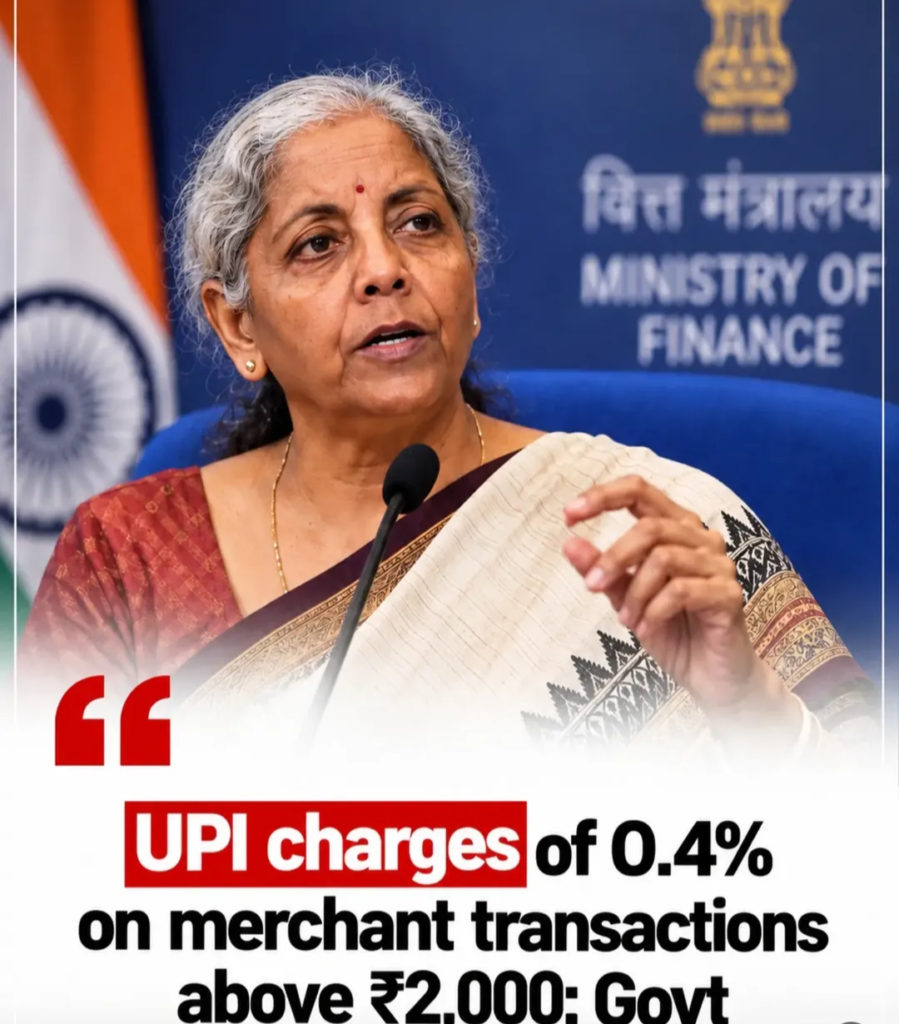
The government and the National Payments Corporation of India (NPCI) have introduced a Merchant Discount Rate (MDR) of 0.4% on certain UPI person-to-merchant (P2M) transactions above ₹2,000. The new charges will come into effect from October 15, 2026.
This ends the nearly six-year zero-MDR regime for larger merchant payments that had been in place to boost digital adoption.
Key Details of the New Framework
0.4% MDR applies to regular P2M UPI transactions above ₹2,000.
For transactions of ₹75,000 and above, the MDR is capped at ₹300 per transaction.
Transactions up to ₹2,000 remain completely free (these form over 95% of P2M volume).
Person-to-person (P2P) transfers stay free regardless of amount.
Small merchants (those receiving up to ₹1 lakh per month via UPI QR under the P2PM category) continue to enjoy zero MDR.
Special rates for certain sectors:
Railways, telecom, insurance, fuel, and some other essential categories will attract a flat ₹5 MDR per transaction above ₹2,000 instead of the 0.4% rate.
Who Pays and Who Does Not
The MDR is paid by the merchant to their acquiring bank. It cannot be passed on to customers. UPI app providers are also barred from levying any platform or additional fee on users.Finance Ministry statements have repeatedly clarified that customers will continue to make UPI payments free of charge.
Why the Change?
The move aims to create a sustainable revenue model for the UPI ecosystem. Banks and payment service providers have long argued that the zero-MDR structure was financially unsustainable as transaction volumes grew massively. A portion of the fee will also support further expansion of UPI among small merchants.
At 0.4%, the rate remains significantly lower than typical credit-card MDR (1.5–2.5%) or debit-card rates.
Impact
Most everyday payments (small-value purchases at kirana stores, street vendors, etc.) will remain unaffected. Larger merchants, e-commerce platforms, and high-value transactions will now bear a modest cost, while the overall system gains long-term viability.
The framework follows recent legislative changes that enabled MDR on select UPI transactions and comes after months of discussion between the government, RBI, and NPCI.