
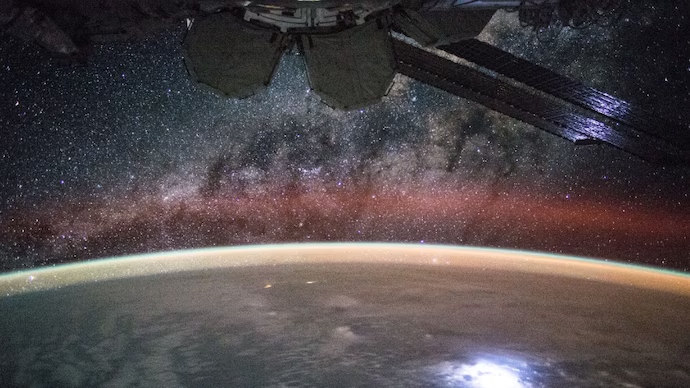
Indian astronaut Shubhanshu Shukla has shared a striking view of Earth from the International Space Station (ISS), highlighting a faint glowing band along the planet’s horizon. The phenomenon, known as airglow, offers scientists a glimpse into the complex chemistry of Earth’s upper atmosphere.
What Is Airglow?
Airglow is a very faint, natural light produced by atoms and molecules in the upper atmosphere. Solar ultraviolet radiation provides much of the energy that drives the process.
During the day, sunlight excites atmospheric molecules and can break them apart. As these atoms and molecules return to lower-energy states or take part in chemical reactions, they release energy in the form of light.
The glow continues on the night side of Earth, although it is normally too faint to see clearly from the ground. From orbit, however, astronauts can observe it as a thin luminous layer around the planet.
Airglow Is Not the Same as an Aurora
Airglow and auroras can appear similar, but they have different causes.
Auroras occur when energetic charged particles associated with the Sun interact with gases in Earth’s upper atmosphere, particularly at higher latitudes.
Airglow, by comparison, is a much more widespread phenomenon driven largely by solar radiation and atmospheric chemistry. It can occur across much of the planet.
Why Does Airglow Have Different Colours?
The colour of airglow depends on the atoms and molecules involved and their altitude.
Green emissions are strongly associated with excited atomic oxygen at around 90–100 kilometres above Earth. Red light can also be produced by atomic oxygen through different energy transitions, while sodium and other atmospheric compounds can contribute to yellow or orange hues.
Why Is Airglow Important to Science?
Airglow is more than a beautiful sight from space. Changes in its brightness and colour can provide information about the composition, temperature and movement of Earth’s upper atmosphere.
Studying this faint glow can therefore help scientists understand a region of the atmosphere that is difficult to observe directly.
Shubhanshu Shukla’s View From the ISS
Shukla, who became the first Indian to visit the ISS, spent 18 days aboard the station as the mission pilot of Axiom Mission 4 in 2025. His latest glimpse of airglow has once again offered the public a fascinating view of atmospheric science from orbit.
The Science Behind the Glow
The thin line seen around Earth may look almost magical, but it is the result of ongoing interactions between sunlight, atmospheric gases and chemistry. From space, the phenomenon becomes a reminder that Earth’s atmosphere remains active even when the planet appears dark below.