
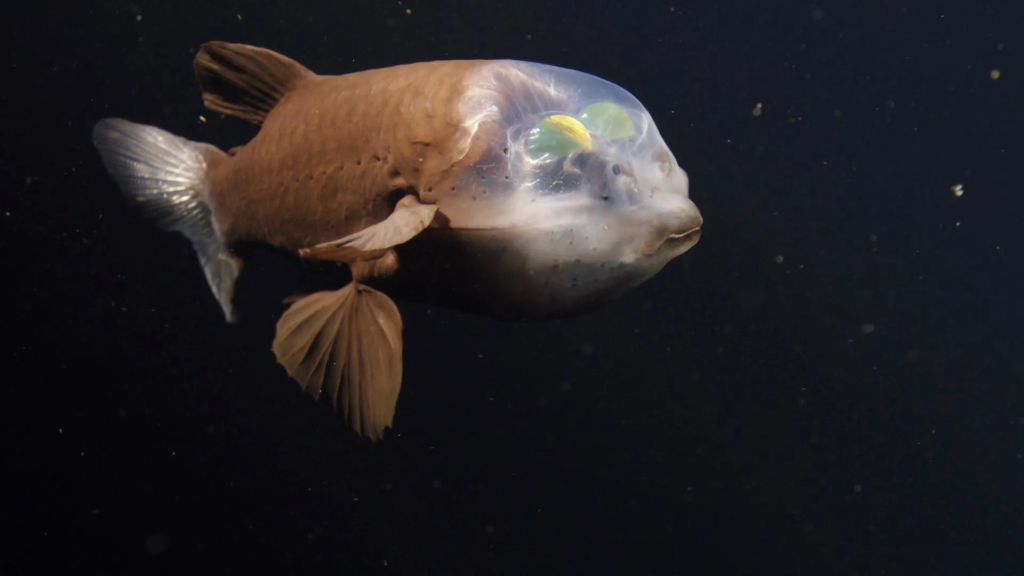
Scientists have captured remarkable 4K footage of one of the ocean’s strangest creatures: the barreleye fish, a rare deep-sea species with a transparent head and unusual rotating eyes.
Researchers from the Monterey Bay Aquarium Research Institute (MBARI) spotted the fish nearly 2,000 feet below the Pacific Ocean’s surface. The encounter offered an extraordinary opportunity to observe how this unusual animal survives and hunts in the ocean’s dark waters.
Rare Sighting During Deep-Sea Expedition
The discovery happened during an eight-day research expedition aboard MBARI’s research vessel David Packard. Scientists were exploring marine life around 90 kilometres offshore when their remotely operated underwater vehicle, Doc Ricketts, encountered the fish at a depth of approximately 600 metres.
The sighting was particularly exciting because MBARI researchers had recorded only 11 encounters with this species during nearly four decades of deep-sea exploration.
Why Does the Barreleye Fish Have a Transparent Head?
The barreleye fish, scientifically known as Macropinna microstoma, has a distinctive transparent dome covering the upper part of its head.
Inside this clear structure are two large, tubular eyes that usually point upwards. The unusual arrangement allows the fish to detect the silhouettes of potential prey moving above it in the dimly lit ocean.
The transparent covering also protects its sensitive eyes while it searches for food among the tentacles of deep-sea siphonophores, jellyfish-like colonial organisms.
Its Eyes Can Rotate to Follow Prey
One of the most fascinating features of the barreleye fish is its ability to rotate its eyes.
When the fish spots potential prey overhead, its eyes can move forward beneath the transparent dome. This allows it to maintain visual contact with food while changing its position to catch it.
Unlike many active hunters, the barreleye can remain almost motionless in the water, using its large fins for stability and controlled movement.
Scientists Capture First 4K Footage of the Species
Researchers observed the fish for approximately 20 minutes using the high-resolution camera aboard the Doc Ricketts remotely operated vehicle.
The team adjusted the underwater lighting to make the transparent head covering easier to see. Scientists also recorded additional three-dimensional footage using the vehicle’s virtual reality camera.
According to MBARI, this was its first 4K recording of the species and the first time researchers had observed it from the institute’s new research vessel, David Packard.
Nearly 7,000 Dives, But Only 11 Encounters
The rarity of this discovery becomes clearer when considering MBARI’s exploration record.
Over nearly 40 years, researchers have conducted around 7,000 remotely operated vehicle dives and collected more than 41,000 hours of deep-sea video. Despite these extensive efforts, they have encountered the barreleye fish only 11 times.
The institute’s previous recorded sighting of this species took place in 2021.
What This Discovery Reveals About Deep-Sea Life
The barreleye fish demonstrates how marine animals develop unusual adaptations to survive in environments where sunlight is extremely limited.
Its upward-facing eyes, transparent head and ability to track prey reveal the complex ways deep-sea creatures locate food and protect themselves.
Researchers believe that studying such animals can provide valuable insights into the biodiversity of the ocean’s midwater region, much of which remains unexplored.
A Rare Window Into the Ocean’s Hidden World
The newly captured footage gives scientists and the public a closer look at a creature that is rarely seen in its natural environment. Beyond its unusual appearance, the barreleye fish offers an example of the extraordinary biological adaptations found beneath the ocean’s surface.
The discovery also highlights the importance of deep-sea research in understanding marine ecosystems and protecting biodiversity