
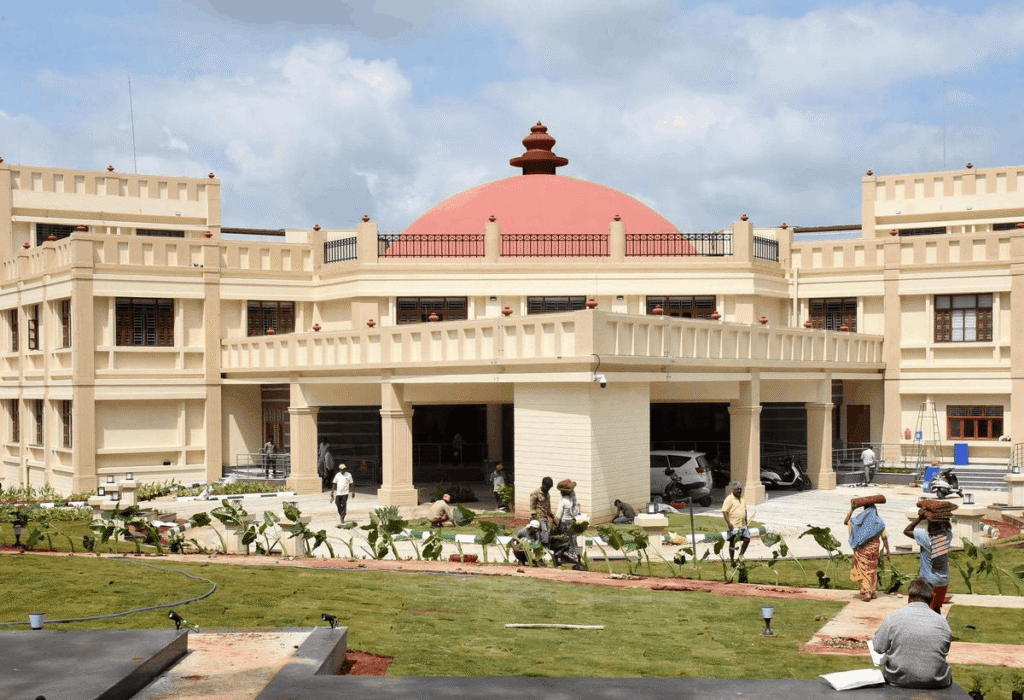
India has taken an important step towards making astronomy more accessible with the inauguration of COSMOS-Mysuru, the country’s first LED dome planetarium. Located at the University of Mysore campus in Karnataka, the advanced facility offers visitors an immersive way to explore stars, planets, galaxies and other wonders of the universe.
Prime Minister Narendra Modi inaugurated the planetarium on November 13, 2026. Developed by the Indian Institute of Astrophysics (IIA) in collaboration with the University of Mysore, the project combines advanced display technology with science education and research.
1. What Is Special About COSMOS-Mysuru?
The biggest attraction of COSMOS-Mysuru is its advanced LED dome display. Unlike conventional planetariums that use projectors to display astronomical images on a curved surface, this facility uses thousands of LED panels to produce visuals directly.
The dome functions like a giant curved screen, allowing visitors to experience detailed images of celestial objects and astronomical phenomena.
This technology is designed to deliver brighter visuals, sharper details and deeper black levels, creating a more immersive viewing experience.
2. An Advanced 8K LED Display System
The planetarium features a 15-metre-wide dome tilted at an angle of 15 degrees. It contains approximately 6,150 LED panels with around 4.2 crore individual LEDs.
The display delivers 8K-resolution visuals, allowing detailed representations of stars, planets, galaxies and other astronomical objects.
The individually controlled LED panels also provide greater flexibility for displaying scientific visualisations and real-time astronomical data.
3. How Is an LED Planetarium Different From a Traditional One?
Traditional planetariums generally depend on powerful projectors that cast images onto the inside of a dome. The quality of the experience depends on the projector system and the surface receiving the images.
COSMOS-Mysuru uses a different approach. Its LED panels generate light directly, rather than relying on an external projection system.
This offers several advantages:
- Sharper images: High-resolution visuals can display astronomical details more clearly.
- Better contrast: LED technology allows deeper blacks and brighter objects.
- Flexible displays: Individual panels can be controlled to create different visual effects.
- Live visualisation: The system can support dynamic presentations of astronomical data.
These features make the facility an important addition to India’s science education infrastructure.
4. More Than a Planetarium: A Centre for Astronomy Education
COSMOS-Mysuru is designed to serve as an astronomy education and training centre rather than simply a place for entertainment.
Its Sky Theatre will screen professionally produced astronomy programmes and an in-house film exploring connections between Mysuru’s history and astronomy.
Shows will be available in Kannada, English and Hindi, helping visitors from different linguistic backgrounds understand scientific concepts.
The facility also aims to encourage students to explore astronomy through educational programmes, workshops and scientific demonstrations.
5. How the Planetarium Can Help Students
Planetariums offer an interactive way to understand concepts that are difficult to imagine through textbooks alone.
Students visiting COSMOS-Mysuru can experience visual presentations about planetary movements, stars, galaxies and the wider universe.
The facility can also support learning across several scientific fields by presenting data and visualisations connected with geology, meteorology, oceanography, chemistry and biology.
The aim is to encourage curiosity and introduce young learners to scientific research and future opportunities in astronomy.
6. Indian Institute of Astrophysics and University of Mysore Partnership
The project has been developed through a collaboration between the Indian Institute of Astrophysics and the University of Mysore.
The Indian Institute of Astrophysics is an autonomous research institution under the Department of Science and Technology, Government of India. It conducts research in astronomy, astrophysics and related areas.
The University of Mysore provides an academic setting for the new facility, strengthening the connection between scientific research and public education.
7. A New Chapter for Science Outreach in India
The inauguration of COSMOS-Mysuru represents a significant development in India’s efforts to improve public access to science and astronomy.
The advanced LED technology provides a new way to present scientific information, while the educational programmes aim to reach students and wider communities.
With its immersive display, multilingual shows and training opportunities, the facility could encourage more young people to develop an interest in astronomy and scientific research.
Conclusion
COSMOS-Mysuru brings together advanced display technology and astronomy education under one roof. Its 8K LED dome offers a different experience from conventional projector-based planetariums while creating new opportunities for scientific learning.
The facility is more than a new attraction for Mysuru. It represents an investment in science communication and the next generation of students who may one day contribute to India’s space and astronomy research.