
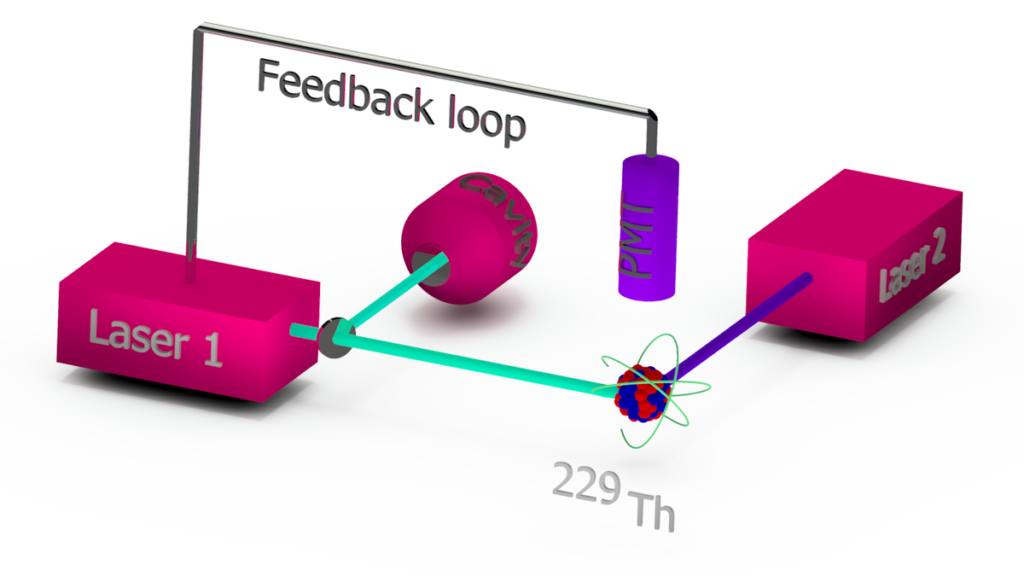
Scientists have reported a major breakthrough in precision timekeeping with the development of the first operational nuclear clocks. The technology uses changes inside an atomic nucleus rather than the movement of electrons, offering a promising new approach to measuring time and studying fundamental laws of physics.
Two research teams independently demonstrated working nuclear clocks, marking an important step towards a technology that scientists have explored for decades.
How Nuclear Clocks Work
Conventional atomic clocks measure specific energy transitions involving electrons surrounding an atom. Nuclear clocks instead use energy changes inside an atom’s nucleus.
The recent experiments rely on thorium-229, an isotope with a nuclear transition that can be reached using specialised ultraviolet laser technology. Researchers embedded thorium nuclei in calcium fluoride crystals and used lasers to detect and stabilise the transition.
Why This Is a Scientific Breakthrough
Building a functioning nuclear clock has been challenging because nuclear transitions are generally difficult to access and measure with lasers. Thorium-229 is unusual because one of its nuclear transitions can be addressed using available laser techniques.
The new experiments demonstrate that this transition can serve as a practical reference for a clock. This takes the concept beyond earlier measurements and brings nuclear-based timekeeping closer to further development.
Could Nuclear Clocks Be More Accurate?
Nuclear clocks may eventually offer advantages over existing atomic clocks because atomic nuclei are less sensitive to some external disturbances than electron shells. This could make future devices more stable and potentially more compact.
However, the new systems are still at an early stage. They have not yet surpassed the best existing optical atomic clocks in overall performance, and researchers will need to improve their stability and accuracy before wider applications become possible.
Potential Uses in Navigation and Technology
Highly precise clocks support satellite navigation, telecommunications, scientific experiments and systems that depend on accurate timing. Nuclear clocks could eventually strengthen these applications if their expected advantages are demonstrated in more advanced devices.
The technology may also help scientists test fundamental physical theories and investigate whether certain physical constants change over time.
A New Tool for Fundamental Physics
The sensitivity of thorium-229 nuclear transitions could allow researchers to search for subtle changes associated with phenomena such as dark matter. Initial experiments have already used nuclear-clock systems to place constraints on some theoretical models.
While practical applications remain some distance away, the development of working nuclear clocks represents a significant milestone in precision measurement and fundamental physics.