
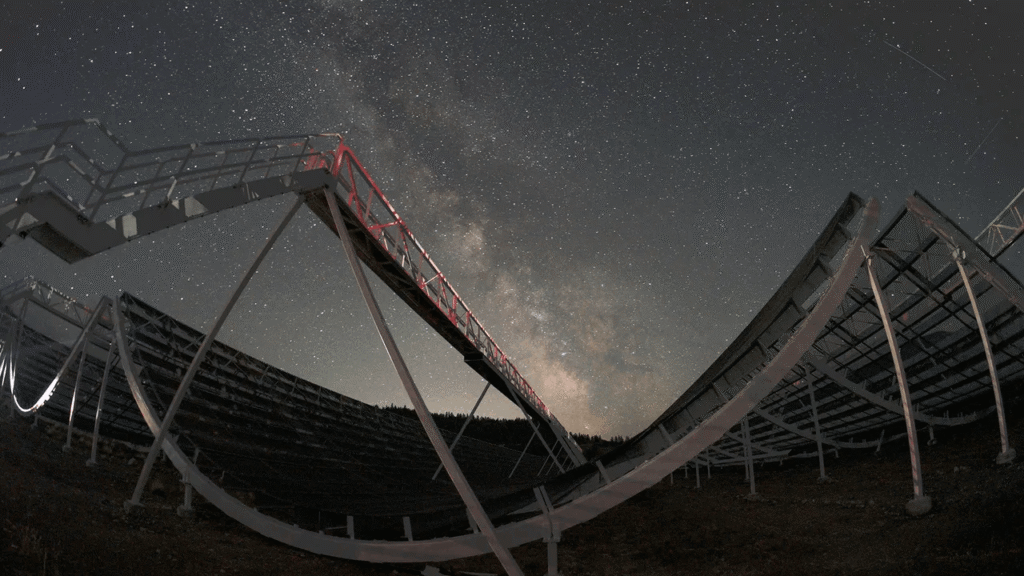
Astronomers have found a new way to study one of the biggest mysteries in cosmology: why the universe is expanding at an accelerating rate. Researchers using the Canadian Hydrogen Intensity Mapping Experiment (CHIME) have successfully detected a faint signal from ancient hydrogen using the telescope’s own data.
A Signal From the Ancient Universe
The hydrogen signal comes from a period when the universe was about five billion years old. By mapping how hydrogen was distributed across space, scientists can trace how the universe expanded over time.
Why Hydrogen Matters
Hydrogen is the most abundant element in the universe and provides a useful way to map large-scale cosmic structures. CHIME was designed to study this hydrogen emission and use it to investigate the history of cosmic expansion.
A New Tool for Studying Dark Energy
The breakthrough could provide scientists with a faster and less expensive method for investigating dark energy, the poorly understood phenomenon associated with the universe’s accelerating expansion. The findings were published in The Astrophysical Journal.
What Comes Next
Researchers plan to expand the observations and use more hydrogen measurements to build a clearer picture of cosmic expansion. The technique could eventually provide new evidence for understanding how the universe has evolved over billions of years.