
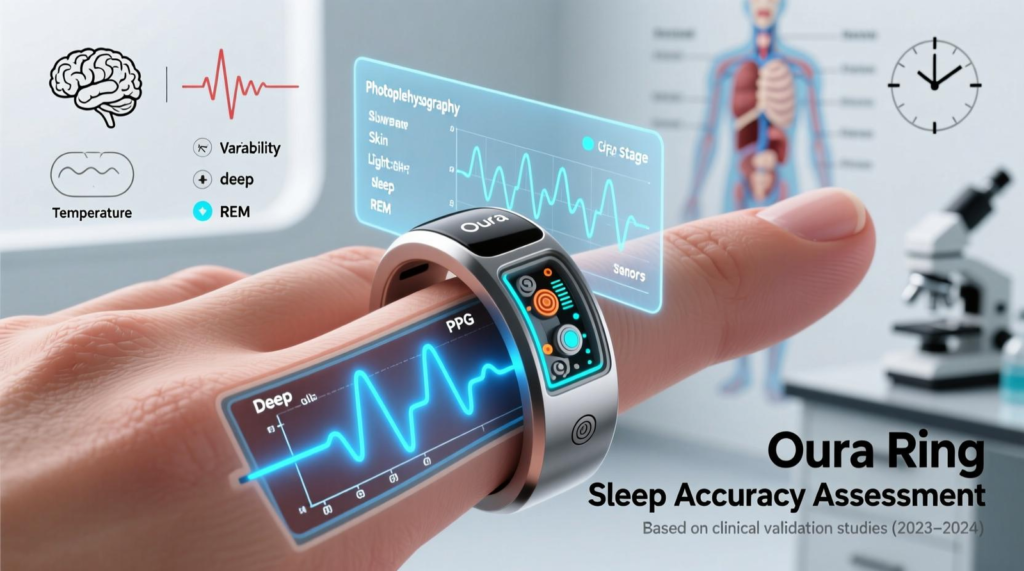
Smart rings have become increasingly popular as people look for convenient ways to monitor sleep, heart activity, movement and other personal data. But a new legal dispute involving Oura is raising a bigger question for the wearable-tech industry: how accurately can a device worn on a finger actually determine what happens during sleep?
A proposed class-action lawsuit filed in California alleges that Oura overstated the accuracy of its sleep-tracking technology. The allegations have not been proven in court, and the case does not establish that Oura’s technology is inaccurate.
What the Lawsuit Claims
The complaint challenges Oura’s marketing around sleep-stage tracking. According to reports on the lawsuit, the company has promoted sleep-staging accuracy figures of up to 95% compared with clinical sleep-lab measurements. The plaintiffs argue that consumers could interpret such claims as meaning the ring can directly measure sleep stages in a way comparable to clinical equipment.
The lawsuit cites an independent study that reported substantially different results for four-stage sleep classification. However, researchers and technology analysts caution that these numbers cannot automatically be compared as if they were measuring exactly the same thing, because studies can involve different devices, participants, algorithms and accuracy metrics.
How a Smart Ring Estimates Sleep
A smart ring does not work like a traditional sleep laboratory.
Clinical sleep studies commonly use polysomnography, which can record brain activity, eye movements and other physiological signals. A ring instead collects signals available from the finger, such as heart rate, movement and temperature, and software uses those measurements to estimate sleep patterns and stages.
That distinction is at the centre of the current debate.
The technology can still provide useful information, but an estimate generated from indirect signals is not necessarily equivalent to a direct clinical measurement.
Why Accuracy Numbers Can Be Confusing
One of the most important issues raised by the controversy is that a single percentage does not tell the whole story.
For example, determining whether someone is asleep or awake is a different task from distinguishing between REM, deep and light sleep. Different studies can also use different definitions of accuracy and different comparison methods.
That means consumers should be careful when interpreting a headline accuracy figure without knowing what was measured, which device and software version were tested, how many people participated and what standard was used for comparison.
Oura Defends Its Science
The lawsuit represents allegations from the plaintiffs rather than a final finding by a court. Oura has maintained that it stands behind its scientific research and accuracy claims.
As the case develops, more attention is likely to focus on the studies behind the company’s advertised accuracy figures and the conditions under which those results were obtained.
What This Means for the Wearable-Tech Industry
The dispute could have implications beyond one smart-ring company.
Wearables are increasingly using algorithms and machine learning to turn relatively small amounts of sensor data into detailed insights. Consumers may see precise-looking numbers on their screens without knowing how those numbers were calculated or how closely they correspond to clinical measurements.
The Oura case therefore raises an important technology question: how should companies communicate the limits of AI-powered health estimates without making the technology appear less useful than it really is?
Smart Rings Are Still Useful—But Context Matters
The controversy does not necessarily mean that smart rings have no value.
Tracking changes over time can help users understand patterns in their activity and sleep. But there is an important difference between using a wearable to follow personal trends and treating its readings as a medical diagnosis.
For consumers, the most useful approach may be to view wearable data as information rather than a definitive medical measurement.
A Bigger Test for Consumer Technology
The Oura lawsuit arrives as smart rings and other wearable devices become more sophisticated and increasingly integrated with AI.
The technology is moving toward a future in which small sensors can generate increasingly detailed predictions about the human body. That makes accuracy, transparency and responsible marketing just as important as the technology itself.
Whatever the outcome of the case, the dispute has opened a broader conversation about how much consumers should trust the numbers produced by their wearable devices—and how clearly technology companies should explain what those numbers really mean.