
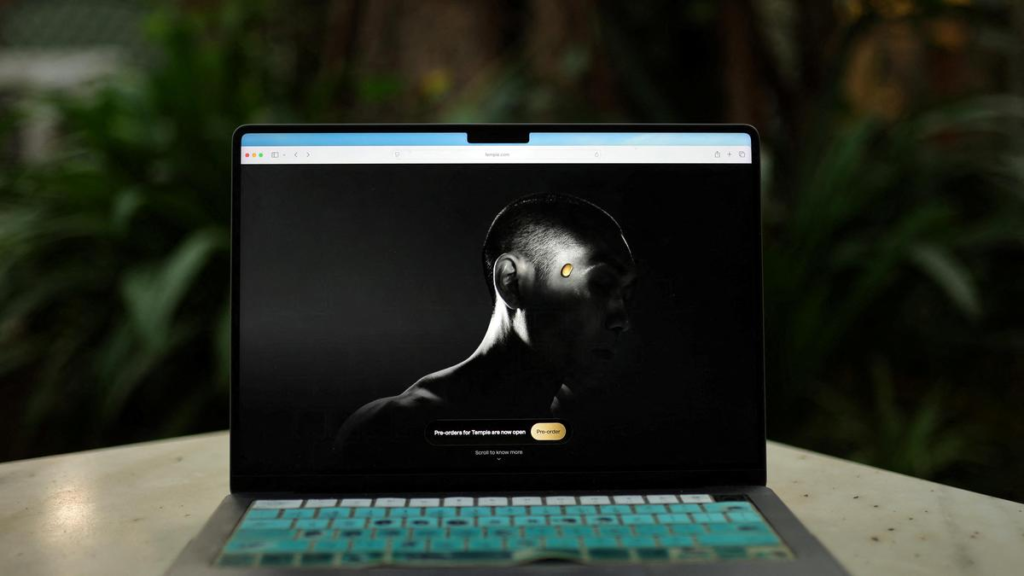
A new wearable device developed by Indian entrepreneur and billionaire Deepinder Goyal has sparked a debate between technology innovators and medical experts. Called Temple, the device claims to monitor brain blood flow and several other health-related measurements. However, doctors have questioned whether its technology can accurately measure circulation inside the brain.
Priced at approximately ₹85,000, the device has attracted attention because of its association with prominent sportspersons, including Indian cricket captain Shubman Gill and badminton star P.V. Sindhu. The controversy has also raised wider questions about the scientific evidence behind wearable health technology.
What Is Deepinder Goyal’s Temple Device?
Temple is a lightweight wearable that attaches to the side of the head, between the forehead and the ear. Weighing less than two grams, it has been designed to collect physiological data through optical sensors.
Its BrainFlow feature is promoted as a way to monitor blood flow to the brain in real time. Another feature, called Entropy, aims to measure how hard the body works to regulate heat.
The company also describes additional measurements relating to thermal, immune, digestive, cognitive and emotional activity. These features are intended to provide users with more information about their bodies and overall wellness.
Why Are Doctors Questioning Its Technology?
Several Indian doctors have challenged the device’s claims, arguing that there is not enough independent, peer-reviewed research to establish its accuracy.
One major concern involves the difference between measuring blood circulation near the surface of the head and measuring blood reaching the brain. The temples contain superficial blood vessels, and an optical sensor placed against the skin may detect signals from these vessels.
Doctors point out that detecting changes in blood volume near the skin does not automatically prove that a device can accurately measure cerebral blood flow.
Neurologists have also stressed that reliable assessment of brain circulation requires appropriate clinical methods and scientific validation. <Cite refs={[“turn766978news4″,”turn766978search0”]}/>
Deepinder Goyal Defends Temple as a Wellness Device
Goyal has responded to the criticism by describing Temple as a fitness and wellness tracker rather than a medical device.
The company has said that BrainFlow and Entropy are based on emerging scientific concepts and that further research will be conducted. It has also acknowledged that some features may require regulatory approval as development progresses.
Temple has referred to early research comparing its BrainFlow readings with transcranial Doppler ultrasound, a recognised technique used to assess blood-flow velocity in certain arteries inside the skull. However, medical experts argue that more extensive independent studies are needed before the device’s measurements can be treated as established clinical evidence. <Cite refs={[“turn766978news4″,”turn766978search0”]}/>
Sportspersons Bring the Device Into the Spotlight
Temple gained additional public attention after being seen on Indian sporting personalities, including Shubman Gill and P.V. Sindhu.
The involvement of well-known athletes has helped bring the product into conversations about fitness, performance and health monitoring. However, doctors caution that celebrity visibility should not be confused with scientific validation.
A wearable may offer interesting information about physical activity or physiological changes, but its readings should not replace professional medical assessments.
The Growing Debate Over Wearable Health Technology
The Temple controversy reflects a wider challenge facing the wearable technology industry. Smartwatches, fitness bands and other connected devices increasingly offer features that claim to monitor different aspects of health.
The key question is where general wellness tracking ends and medical measurement begins. A device that provides lifestyle information may not require the same level of clinical evidence as one claiming to identify or monitor a medical condition.
Similar questions have emerged internationally around blood-pressure and other health-related features offered by wearable technology companies. Regulators are increasingly examining whether certain functions should be treated as medical products.
What Should Consumers Keep in Mind?
Consumers should be careful about interpreting wearable-generated health scores, particularly when those scores relate to complex functions such as brain circulation.
Doctors emphasise that brain health cannot be assessed through a single measurement. Factors such as blood pressure, diabetes, cholesterol, sleep, physical activity and neurological symptoms all play important roles.
People experiencing symptoms or concerns about their brain health should seek medical advice rather than relying on an unvalidated wearable reading.
A Test for India’s Health-Tech Innovation
Deepinder Goyal’s Temple venture highlights India’s growing ambitions in wearable technology and preventive wellness. The device has attracted international interest, with Goyal saying it has received orders from more than 62 countries since November 1, 2026. The company also reportedly raised $54 million earlier this year.
However, commercial interest must be matched by scientific transparency and reliable evidence. Independent research, larger validation studies and appropriate regulatory oversight will be important in determining how useful Temple’s technology can become.
The debate is ultimately about more than one wearable device. It highlights the need to balance innovation with scientific responsibility when technology makes claims about human health.