
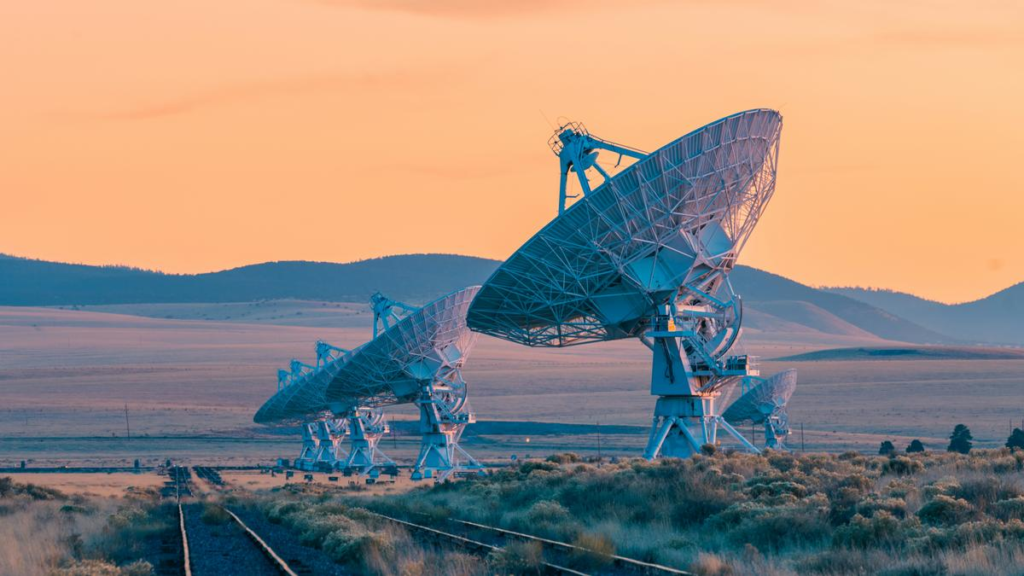
The growing number of communication satellites orbiting Earth is creating a new challenge for astronomers: radio signals emitted by satellites can interfere with the faint signals scientists use to study the universe.
A recent study published in the Monthly Notices of the Royal Astronomical Society found that satellites in low Earth orbit produce not only intended communication signals but also unwanted emissions and radiation from onboard electronics. These signals can disrupt sensitive radio astronomy observations, making it harder for researchers to detect distant cosmic objects.
How Satellite Radiation Affects Astronomy
Radio telescopes detect extremely faint electromagnetic signals from objects such as stars, galaxies and gas clouds. Satellite transmissions can be far stronger than these natural signals, potentially overwhelming the instruments designed to capture them.
Researchers classify the interference into three main types: intended transmissions used for communication, unwanted emissions that spill beyond their intended frequencies, and unintended radiation generated by electronic equipment aboard satellites.
The distinction matters because even signals that are not deliberately transmitted can affect scientific measurements.
What the SNIFFLES Study Discovered
The research programme, known as SNIFFLES, tracked satellites from major constellations, including Starlink, OneWeb, Amazon Leo and China’s Guowang. Using the Mopra radio telescope and the Australia Telescope Compact Array, researchers conducted 4,629 satellite-tracking observations covering nearly 376 hours.
The team recorded 2,345 instances of satellite emissions across more than 300 distinct frequencies. Some signals were detected within frequency bands protected for radio astronomy, raising concerns about their potential to interfere with scientific observations.
Why Even Unintended Signals Matter
Satellites contain computers, power converters and other electronic systems that can generate unintended electromagnetic radiation. Although these emissions are not necessarily produced for communication, they can still affect sensitive radio telescope equipment.
Researchers detected unintended radiation around 2,700 megahertz in approximately 77% of observations involving a particular satellite version. Follow-up measurements also found some signals up to 11 orders of magnitude brighter than typical astronomical sources, potentially overwhelming radio telescope receivers.
A Growing Challenge for Space Science
The expansion of satellite networks has brought significant benefits, including internet connectivity in remote areas. However, the increasing number of spacecraft creates a more crowded electromagnetic environment for scientific research.
Radio astronomy is particularly vulnerable because observatories study extremely weak signals from distant objects. Satellite transmissions and electronic emissions can make it difficult to distinguish natural cosmic signals from human-made interference.
Satellites can also affect optical astronomy by reflecting sunlight and leaving bright trails across telescope images. This is a separate problem from radio interference, but both issues are drawing greater attention as satellite constellations expand.
Can Satellite Interference Be Reduced?
Scientists and satellite operators are exploring ways to limit the impact on astronomical observations. Possible measures include reducing unwanted emissions, improving electronic shielding, coordinating transmission frequencies and designing satellites to minimise interference.
International cooperation will be important because satellite signals can affect observatories across national borders. Researchers also emphasise the need to distinguish between regulated transmitter emissions and unintended radiation from other onboard electronics.
What This Means for Future Astronomy
The findings highlight a growing challenge for modern astronomy as satellite networks expand. While satellite technology supports global communication, its effects on sensitive scientific instruments need to be addressed to protect future discoveries.
Further monitoring and collaboration between astronomers, regulators and satellite companies could help ensure that communication networks and astronomical research can continue to coexist.