
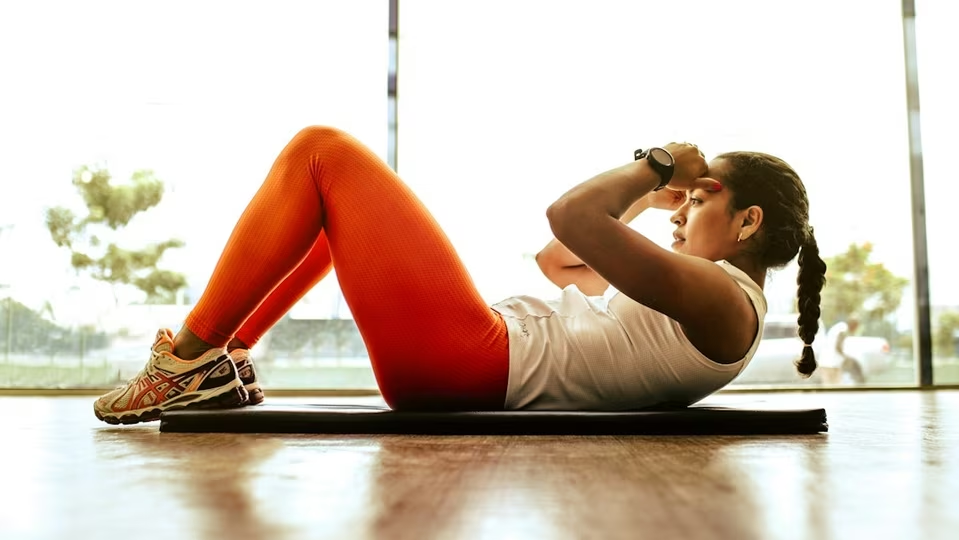
You do not always need a gym membership or expensive equipment to build a consistent fitness routine. A well-planned home workout can combine basic bodyweight movements to train different muscle groups and improve overall strength.
If you are short on time or prefer exercising at home, these five movements can form the foundation of a simple routine.
1. Squats
Squats are one of the most useful lower-body exercises and work the thighs, hips and glutes.
Stand with your feet roughly shoulder-width apart, lower your hips while keeping your chest lifted, and return to the starting position. Beginners can start with bodyweight squats and focus on controlled movement rather than speed.
2. Push-Ups
Push-ups work several areas of the upper body, including the chest, shoulders and triceps, while also requiring core stability.
If a standard push-up feels too difficult, beginners can start with an easier variation, such as performing the movement from the knees or against an elevated surface.
The goal is to gradually improve strength and control rather than forcing out repetitions with poor form.
3. Rows
A home routine should not focus only on pushing movements. Rows can help train the muscles of the back and provide balance to an upper-body workout.
Depending on what is safely available, rows can be performed using resistance bands or suitable equipment. If using furniture for support, make sure it is stable and designed to bear the required load.
4. Glute Bridges
Glute bridges are a simple way to train the muscles around the hips and buttocks.
Lie on your back with your knees bent and feet planted on the floor. Lift your hips while keeping your core controlled, pause briefly at the top and lower yourself slowly.
Because the movement is relatively low impact, it can be a useful addition to a beginner-friendly home routine.
5. Planks
Planks focus on core stability rather than repeated movement. They can also help you practise maintaining a controlled body position.
Start with a short hold that you can perform with good form. As your endurance improves, gradually increase the duration rather than immediately trying to hold the position for several minutes.
How to Build a Simple Home Routine
These five exercises can be combined into a short full-body workout. Beginners should start with a manageable number of repetitions or short holds and allow adequate recovery between sessions.
Consistency matters more than trying to make every workout extremely difficult. As exercises become easier, you can gradually increase repetitions, resistance or time under tension.
Can Home Workouts Help With Fat Loss?
Exercise can contribute to overall energy expenditure and help maintain or build muscle, but fat loss is influenced by total energy intake, physical activity and other lifestyle factors.
A workout alone does not guarantee fat loss. Combining regular exercise with a balanced eating pattern and adequate recovery is a more sustainable approach.
Focus on Form Before Intensity
One of the biggest advantages of basic exercises is that they allow you to concentrate on movement quality.
Start at a level that matches your current fitness. Stop if you experience sharp pain, dizziness or unusual symptoms, and seek professional guidance if you have an injury or medical condition that could affect exercise.
The Takeaway
A useful home workout does not need to be complicated. Squats, push-ups, rows, glute bridges and planks can provide a simple starting point for training different muscle groups without relying on a full gym setup.
The key is to start gradually, maintain good technique and build consistency over time.