
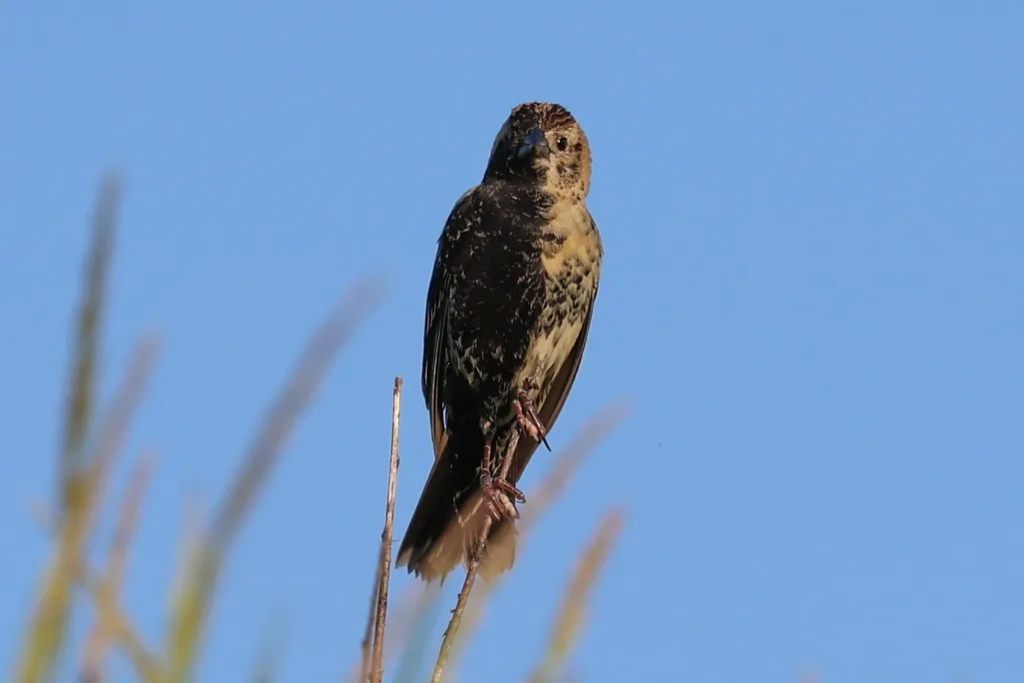
A birdwatching trip near Chicago recently produced a remarkable surprise when a conservationist discovered a bobolink that appeared to have two distinctly different appearances on the same body.
The unusual bird was spotted at Hill ’N Dale Preserve in Barrington Hills, Illinois, where conservationist Luke Dahlberg was photographing bobolinks arriving for their breeding season. At first, the bird’s unusual colouring seemed like nothing more than an odd variation. A closer look several weeks later revealed something far more extraordinary.
A Perfect Divide Down the Middle
The bird, later nicknamed “Black and Tan,” displayed classic male characteristics on one side of its body and female characteristics on the other.
Its right side showed the striking black-and-white appearance associated with a male bobolink during breeding season, while its left side carried the softer brown and golden colouring normally seen in females.
Experts identified the bird as a bilateral gynandromorph—a rare biological phenomenon in which an animal develops male and female characteristics in different parts of its body.
The division was so clear that observers described it as almost a straight line running down the bird’s body.
From an Odd Photograph to a Scientific Discovery
Dahlberg initially noticed the bird while reviewing photographs he had taken in May. Because bobolink males change their appearance outside the breeding season, he first wondered whether the bird was simply going through an unusual molt.
When he returned to the preserve and encountered the same bird again, however, its unusual two-sided appearance was unmistakable.
The discovery prompted bird experts, including conservation ecologist Cameron Rutt of Chicago’s Field Museum, to examine the bird more closely. Rutt reportedly took around 1,000 photographs while documenting the rare visitor.
The Rare Bird Behaved Like a Male
The unusual appearance wasn’t the only fascinating part of the sighting.
Despite having both male and female characteristics, the bobolink behaved like a male during the breeding season. It sang, performed courtship flights and established a territory while attempting to attract a mate.
According to reports, the bird eventually succeeded. It nested, reproduced and raised fledglings before leaving the preserve.
That behaviour made the observation even more interesting for researchers because it provided an opportunity to see how an exceptionally rare biological condition could affect the bird’s behaviour.
Why This Sighting Is So Unusual
Gynandromorph birds are extremely uncommon. The condition has been documented in only a small number of individual birds across a limited range of species, making a sighting in the wild particularly unusual.
Researchers believe the phenomenon is connected to an error during the formation of reproductive cells, although the precise biological process can be complicated. In a gynandromorph, different groups of cells can carry male and female genetic characteristics, resulting in the striking physical division seen in animals such as this bobolink.
Experts believe this may be the first documented gynandromorphic bobolink, adding another reason the Chicago-area discovery has attracted scientific interest.
A Visitor That May Return
The extraordinary bobolink has now left the preserve, ending its brief appearance in the Chicago area.
For the birdwatchers who encountered it, however, the sighting was something they are unlikely to forget. Dahlberg hopes the unusual bird will return during the next breeding season.
Until then, “Black and Tan” remains a remarkable example of how even familiar wildlife can occasionally reveal something completely unexpected.
A routine day of bird photography turned into a rare natural-history discovery and gave Chicago-area birdwatchers a glimpse of one of nature’s most unusual biological phenomena.